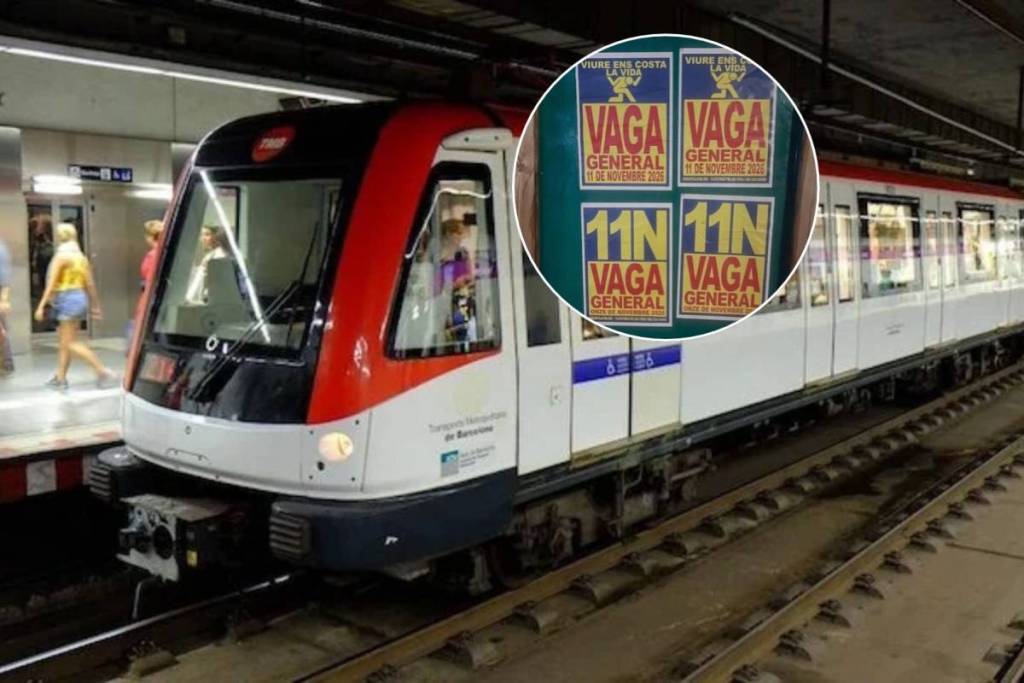

Barcelona and the entire region of Catalonia are preparing for three consecutive days of disruptions to their normal operations due to the general strike on November 11. On November 10, 11, and 12, two separate union strikes will have a major impact on transportation, healthcare, education, and all public and private services in the region.
On Tuesday, November 10, and Thursday, November 12, the SEMAF union has called for a strike by Renfe train operators in response to the stalemate over railway safety regulations. The climax will come on Wednesday the 11th with a general strike organized by UGT, CCOO, and CGT to demand better wages and access to housing—a mobilization that will reduce bus and subway service to a minimum and force adjustments to staffing levels at hospitals, schools, and public service offices.
Renfe Trains (November 10 and 12)
During these two days, the train drivers’ strike will run from 12:01 a.m. to 11:59 p.m. Commuter and regional rail services in Catalonia will operate with the following minimum service levels:
- Rush hours (6:00 a.m. to 9:30 a.m. and 5:00 p.m. to 8:30 p.m.): 66% of normal service.
- Off-peak hours (rest of the day): 33% of trains.
- Staff at operations and maintenance centers will be on hand to handle urgent breakdowns.
TMB
Wednesday’s general strike will severely disrupt commuter trains, regional trains, the Barcelona Metro, TMB buses, FGC trains, and trams. The Department of Business and Labor has established the following restrictions for travelers:
- Rush hours (6:30 a.m. to 9:30 a.m. and 4:30 p.m. to 9:00 p.m.): Only 25% of services will be operating.
- Off-peak hours: There are no guaranteed minimum services; transportation could come to a complete standstill.
- Exceptions: The Aerobús will operate at 50% capacity. School buses for which there is no public alternative and vehicles for people with disabilities will operate as usual. Union representatives such as Juan Guerrero, secretary at Tusgsal, have confirmed unanimous support for the strike among their staff, a situation that is also the case at Marfina Bus.
Healthcare and Pharmacies
The healthcare system will prioritize critical care and hospitalized patients, operating largely as it would on a holiday:
- Full attention required: Hospital emergency rooms, continuous care centers (CUAP, PAC, PADES), ICUs, delivery rooms, hemodialysis units, coronary care units, and neonatal units.
- Treatments and procedures: Emergency surgeries and life-saving chemotherapy and radiation therapy sessions are guaranteed.
- Primary Care Centers (CAPs): They will operate with 25% of their staff to handle non-urgent cases.
- Pharmacies: They will maintain their usual service and on-call shifts.
Education and Schools
Public and private non-university educational institutions will apply the following student-teacher ratios:
- Management team: One person per center.
- Preschool and elementary school (ages 3 to 12): One teacher for every six classrooms.
- Daycare centers and cafeterias: 33% of the workforce.
- Special education (ages 3–16): 50% of staff.
Social Services
Services for vulnerable individuals will be maintained at essential minimum levels:
- Nursing homes (for the elderly and people with disabilities): They will operate as they would on a holiday. If staffing levels match those of a workday, 85% coverage will be guaranteed.
- Telecare: 85% of the staff on standby for emergencies.
- Soup Kitchens: Weekend Hours and Services.
- Day centers: Meals guaranteed; other services at 50% capacity.
Emergencies, safety, and utilities
- Telephone Services: The 112 emergency number and other emergency lines will operate at 85% capacity.
- Firefighters and private security: Minimum on-duty staff and basic crews at key infrastructure sites.
- Utilities (water, electricity, gas): Only urgent repairs that threaten public health or safety will be carried out.
- Roads and highways: Emergency response teams for incidents and one-third of maintenance staff.
Administration, justice, and others
- Notice to the public: Three staff members per office (four in the Administrative District). For procedures that cannot be postponed, one staff member will be available per service.
- Justice and Prisons: Judicial on-call services and 100% of management staff at correctional facilities.
- Funeral services: 85% of staff for the collection of the deceased and 50% for administrative duties.
- Public media: 50% of news programming.