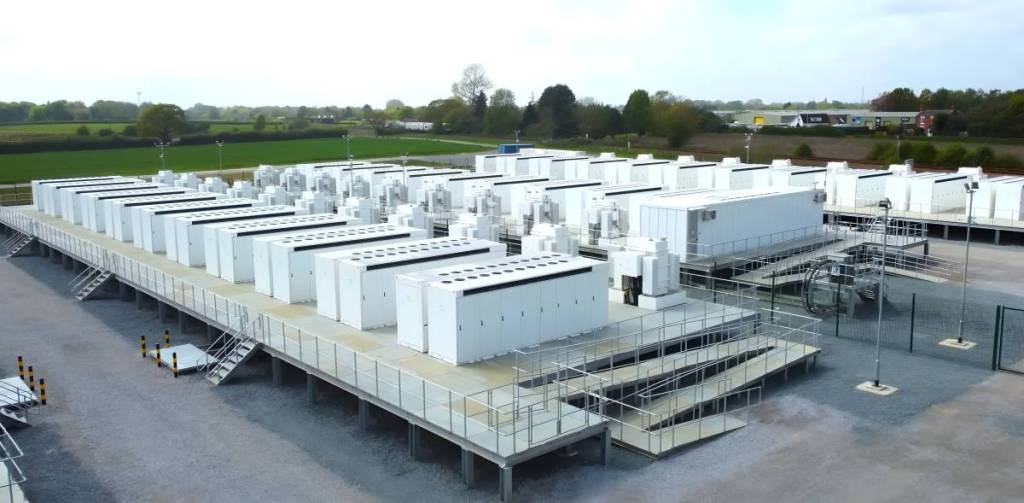

The sun that gently beats down on our rooftops and the wind that sweeps across the regions aren’t always enough if we have nowhere to store their power. In a changing landscape striving to put the memory of the 2025 blackout behind it, Catalonia is preparing to bring its first large-scale battery farms online in 2027. These facilities, designed to store excess energy during the day and release it when night falls or demand spikes, will begin to spring up both independently in municipalities such as Sant Julià de Ramis and integrated with existing solar farms in towns like Alcarràs.
The kickoff for this new safety net coincides with the first edition of the Battery & Energy Storage Tech Europe conference, being held at the Fira de Barcelona exhibition halls. There, while Catalan authorities are processing more connection permits than any other region in Spain, experts and companies are debating how to convince the most reluctant municipalities and how new materials—beyond the well-known lithium—can make the region a leader in grid stability to compensate for its current lack of purely renewable generation.
The Challenge of Storing Electricity
The Department of Territory, Housing, and Ecological Transition is clear that the ability to store electricity is essential for ensuring the system’s reliability. Since the region still has a modest number of solar and wind farms, the strategy involves promoting large, independent facilities that function as massive energy reservoirs.
These energy storage facilities, covered by a new regional decree, will not rely solely on batteries. The proposed storage ecosystem also includes harnessing water through pumped-storage power plants at reservoirs such as La Baells, Moralets, and Riba-roja. The regional government hopes that the first facilities to be built will serve as a user-friendly showcase to demonstrate to residents that this is a safe and necessary model.
Profitability and Community Education
The local industry is already feeling the shift. Roger Casals, head of the company Wattium, confirms that interest in installing these facilities continues to grow thanks to new regulations. “The price of batteries has dropped enough that many projects are now profitable,” he notes.
However, the human factor remains an obstacle. Casals points out that there is still a great deal of “public ignorance,” so it is vital to explain to people in simple terms exactly what these energy storage units are for. To speed things up, the sector is calling for the PLATER—the document that is supposed to outline the definitive plan for where and how this infrastructure can be built throughout the region—to be unstuck.
The Salt of the Earth: The Shift to Sodium
In the halls of Fira de Barcelona, the talk isn’t just about permits—it’s also about chemistry. The race to find sustainable alternatives to lithium is one of the highlights of the event. Agustí Chico, from Eurecat and BATTECH, puts an unexpected candidate on the table: sodium.
“We have sodium in large quantities, whereas lithium and other materials in its family are harder to obtain,” explains Chico. Although it’s true that sodium batteries need to be larger to store the same amount of energy, this isn’t a problem for stationary parks in the middle of the countryside, where space is plentiful—unlike inside a car. The expert also points out that, before manufacturing more, we need to think about recycling: “It’s essential to better understand the degradation and lifespan of these technologies to know how to approach reuse.”
Cybersecurity and a Golden Opportunity
With increasingly interconnected infrastructure, the fear of a system failure no longer stems solely from a broken cable but from the digital network itself. Joan Herrera, from the organization Oikia, emphasized during the conference that cybersecurity will be the essential bulwark for protecting these new facilities.
Herrera points out that Catalonia is lagging behind in both electrification and the large-scale deployment of renewables. Precisely for this reason, he insists that taking the lead in installing these large, independent energy storage facilities is an “opportunity” that the region simply cannot afford to let slip away.