
Climbing Montjuïc always feels a bit like a ritual of disconnection, a way to leave the asphalt behind and lose oneself among museums and viewpoints that, even though we think we know them by heart, always have a trick up their sleeve. The magical mountain is an expert at hiding corners that, for one reason or another, have remained off theradar of the regular visitor for decades. Sometimesthese are gardens closed for maintenance; other times, they are spaces that simply weren’t part of the official tour route of the institutions that oversee them.
That is precisely what has just changed at one of the most iconic buildings on Barcelona’s cultural skyline. The Fundació Joan Miró, that flagship of Josep Lluís Sert’s architecture, has decided it was high time for visitors to stop looking out the window and start taking action. As part of its 50th anniversary, the museum has completely revamped its approach to become more open, more “democratic,” and, above all, greener.
A 240-square-meter treasure designed by Forestier
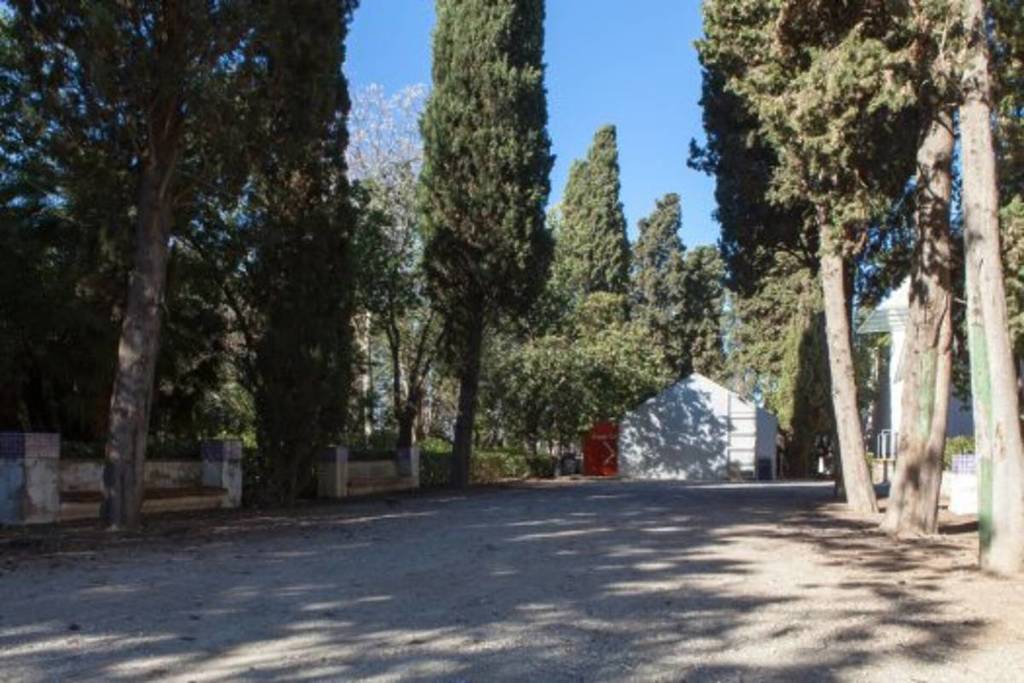
The big news this season isn’t just the white walls inside, but at the western end of the grounds. It is the Garden of the Cypresses, a space that until now felt like a private annex and is now fully integrated into the museum experience. It is no ordinary garden: its original design bears the signature of Jean-Claude Nicolas Forestier, the French landscape architect who transformed Montjuïc for the 1929 Exposition and who gave us gems such as the Laribal Gardens.
Covering an area of about 240 square meters and with a capacity to accommodate more than 250 people, this spot is not just a simple passageway. It is an oasis of silence flanked by cypress trees that now serves as an extension of the exhibition halls. Best of all, it has direct access from the street and connects to the temporary exhibition halls, allowing for a constant dialogue between the stone, the vegetation, and the Barcelona sky.
The Return of ‘Mujer’ and the New Life of the Collection
But what would a garden at the Miró be without a piece that gives it meaning? The major visual draw of this opening is the outdoor installation of the sculpture ‘Woman’ (1970). Joan Miró’s bronze figure seems to have found its natural habitat among the trees, reinforcing the artist’s idea that art should not be enclosed, but in direct contact with the elements. It is, probably, one of the most powerful “photo opportunities” we’ll have this year in the city.
This opening is not an isolated event, but rather the tip of the iceberg of a comprehensive overhaul in the way we understand the Catalan genius. The Foundation has revamped the layout of its permanent collection, moving away from boring chronological schemes to focus on creative processes. Now, the visit is much more organic: you can see how an idea was born in a sketch and, just a few steps later, encounter that same energy materialized in a historic garden under the March sun.