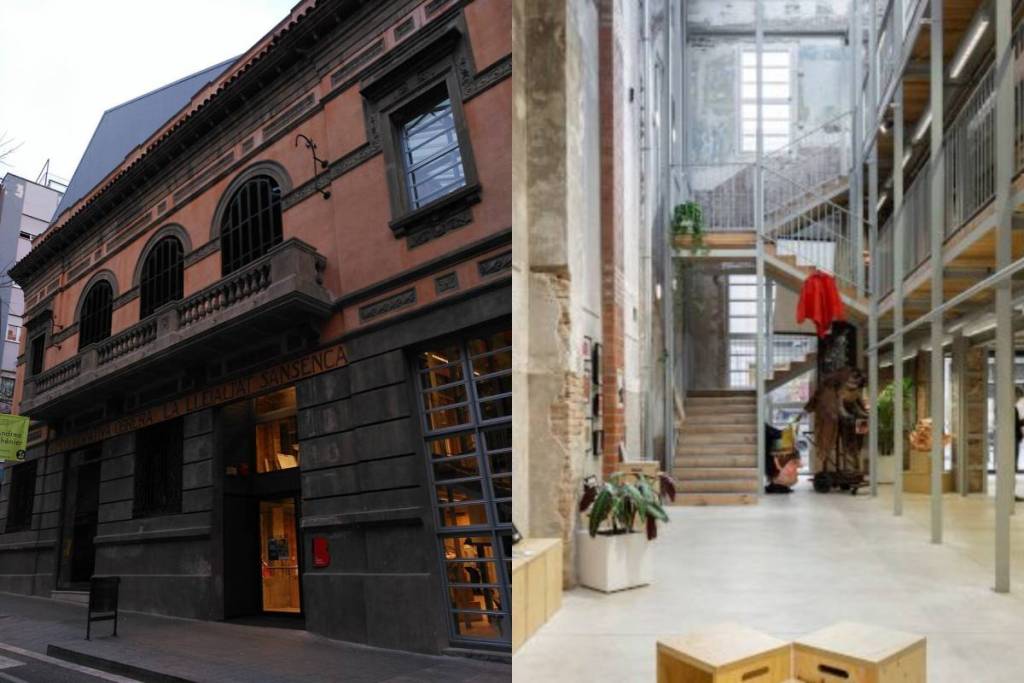

It is impossible to understand today’s Barcelona without delving into the origins of its neighborhoods and listening to the stories of the residents who, little by little, shaped the identity and soul of the city and its streets. Stories like that of the Lleialtat Santsenca, currently a municipal building dedicated to promoting culture and building community, but which in the past was the headquarters of a legendary workers’ cooperative.
The current building was constructed nearly a century ago, in 1927, by the Catalan architect Josep Alemany, but the association’s origins date back to the late 19th century. In 1894, fifteen workers from Sants (at that time an independent town) founded a cooperative with the aim of organizing themselves to purchase basic necessities in bulk, prevent price gouging, and sell them to members at fair prices.
Within a few months, they had already doubled their membership, and ten years later, the cooperative consisted of more than one hundred people. Their exponential growth and success led them, in 1923, to begin minting their own cooperative currency, effectively becoming a sort of “mint” in Sants.
A few years later, it moved to 31 Olzinelles Street—its current location—into a new building notable for its size and its Noucentista façade, which today looks virtually the same following its restoration in 2017.
From Cooperative to Nightclub
After the Civil War, the Franco regime seized the property, and it was not until 1941 that the workers’ cooperative reopened under the supervision of the Falange. However, the Lleialtat Santsenca did not survive the economic downturn and closed permanently in 1950.
For nearly 40 years, the space served as the Torrons Viar factory and store, while the upper floor housed the iconic Bahía nightclub. This dual commercial and recreational use continued until 1988, when the Barcelona City Council closed the premises due to a lack of permits.
A decade of neighborhood activism to save it from demolition
After being closed for nearly 20 years, the building was occupied by the association Espai Alliberat per la Cultura in 2006, and after they were evicted in 2009, the Plataforma Recuperem la Lleialtat Santsenca was created, bringing together more than 60 neighborhood associations.
Faced with the threat of demolition or sale to a private company, the residents of Sants launched a long-running protest, demanding that it be turned into a space for youth and the community. In 2011, the City Council took ownership of the building, and renovation work began three years later.
In January 2018, the Lleialtat Santsenca reopened its doors and became the neighborhood community center it is today. It is a public space where people can attend debates, lectures, sports workshops, exhibitions, games, and an endless list of activities designed for the residents of Sants and Barcelona.