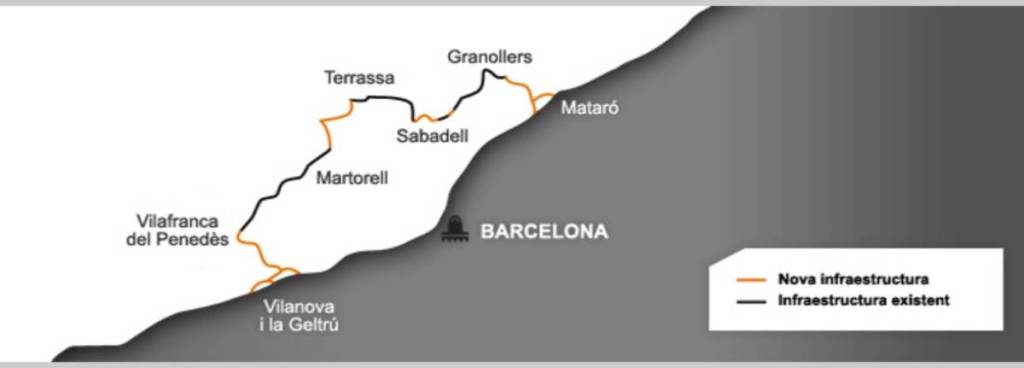

The Government of Catalonia has formally revived the Orbital Train project, a rail infrastructure originally designed two decades ago to serve the third metropolitan ring. The proposal, which has been revived from the archives as part of Catalonia’s Railway Strategy and budget negotiations, aims to link cities such as Mataró, Granollers, Sabadell, Terrassa, Martorell, Vilafranca, and Vilanova i la Geltrú along the perimeter.
Although the Rodalies network is facing a complex situation, progress on this plan is currently focused on resolving mobility issues between Vallès Oriental and Vallès Occidental. The Ministry of Transport is already working on the preliminary study for the section that will directly connect Sabadell and Granollers, with results expected before the end of this year.
A network of 119 kilometers and 39 stations
The technical design, which stems from the Urban Master Plan approved in 2010, calls for a line with a total length of 119 kilometers. Of the proposed route, 68 kilometers would be newly constructed, while the rest would utilize existing infrastructure, such as the R3, R4, and R8 lines.
The project calls for the establishment of 39 stations, 18 of which would be newlybuilt. In addition, the network would include 12 transfer hubs to facilitate connections with other lines operated by Renfe and Ferrocarrils de la Generalitat (FGC). According to technical estimates, once fully operational, the infrastructure could handle a demand of 20 million passengers annually.
Priority on connecting the two Vallès regions
The deployment of the infrastructure is planned in separate phases. The Catalan Government is giving absolute priority to the section connecting Granollers with Sabadell. This route would involve linking the two stations in Granollers, utilizing sections of the R3 line, and building a new track between Santa Perpètua and Sabadell.
The section between Terrassa and Martorell is a second priority. Although passenger demand is expected to be somewhat lower, the Association for the Promotion of Public Transport (PTP) highlights its strategic value in enhancing the network’s resilience, allowing freight transport to avoid passing through the Rubí tunnel.
Doubts about the design in the Maresme and Garraf regions
The original plan also includesnew construction sections between Vilafranca and Vilanova, as well as between Granollers and Mataró. However, these phases are considered longer-term projects.
The design of potential “rail loops” in Mataró and the Vilanova-Sitges area has sparked debate. Adrià Ramírez, spokesperson for the PTP, has described these specific proposals as overly complex, noting that the immediate priority must be the maintenance and improvement of the current network. For their part, the authorities are maintaining a cautious stance, trusting that the preliminary studies will align the territorial plan with actual rail needs.