
The corner of Paral·lel that for years smelled of theater now smells of Italy and fine dining. Osteria Condal, the Orobianco Group’s new Italian restaurant, occupies the space at 164 Paral·lel Avenue, where Albert Adrià opened Tickets in 2011 and which later housed Teatro Kitchen Bar. Two restaurants that made a strong commitment to the theater and left a legacy of culinary excellence that’s hard to ignore. One as the most sophisticated reinterpretation of tapas seen to date. The other as an example of how to take up the torch without getting burned. Both hold a Michelin star.
The current concept takes a different approach. The kitchen is open-concept and led by Paolo Casagrande, executive chef at Lasarte—Barcelona’s three-Michelin-starred restaurant—alongside a team of in-house chefs. The menu blends Italian and Catalan cuisine and is structured around à la carte options and two tasting menus served to the entire table: Frenesia (€70, with a wine pairing option for €40) and Paral·lel (€90, wine pairing for €60). And
this shift in tone is also evident on the walls. The interior is the work of Astet Studio, which has scaled back the grandeur of the two previous venues and focused on materials: red tile and blue marble instead of ornate decor and artifice. The result is a dining room that is more serene than theatrical.
Recommended Articles
 Where Catalonia Appears in GTA VI: Where to Find Catalan Bay and Other Avenues Dedicated to Catalonia in the Game Coming Out Tomorrow
 The “Titanosaur” Appears in Catalonia: Its Neck Alone Measures 7 Meters and It Is the Largest Archaeological Remnant of Its Kind Found in Europe
The Italian from Barcelona: from “cap i pota” tortellini to fregola marinera
Osteria Condal presents itself as the contradiction suggested by its name: an osteria (a traditional Italian eatery) filtered through the technical lens of haute cuisine and rooted in Catalan ingredients. It is neither a typical trattoria nor a rigid fine-dining establishment; the menu allows guests to either sit down and work their way through an extensive menu or order à la carte and let themselves be carried along by the rhythm of the table.
The fusion of Italian and Catalan influences is evident the moment you open the menu. The appetizers feature dishes that perfectly encapsulate this two-way dialogue: cap i pota tortellini with chickpea broth (€20) or artichoke and romesco panna cotta (€18). There’s also room for Casagrande’s own creations, such as the “carbonara”-style squid tartare (€18), alongside more globally inspired dishes like Iberian pork shoulder with seaweed and dashi (€22) or onion curd with mantis shrimp and salsify (€20).
When it comes to main courses, the cuisine makes a strong statement without losing its sweet touch. The saffron risotto is served with tongue and green sauce (€22); the spaghettoni are dressed to the nines with bisque and lobster (€38); and the oxtail cannelloni is topped with black trumpet mushrooms and eel (€24). Those looking for fish or meat will find seasonal dishes with carefully crafted bases: grilled red mullet with chanterelles and kale (€32), monkfish tail with cauliflower and miso (€36), charcoal-grilled venison with Belgian endive and chestnuts (€36), or beef tenderloin with potato mille-feuille and pine nuts (€38).
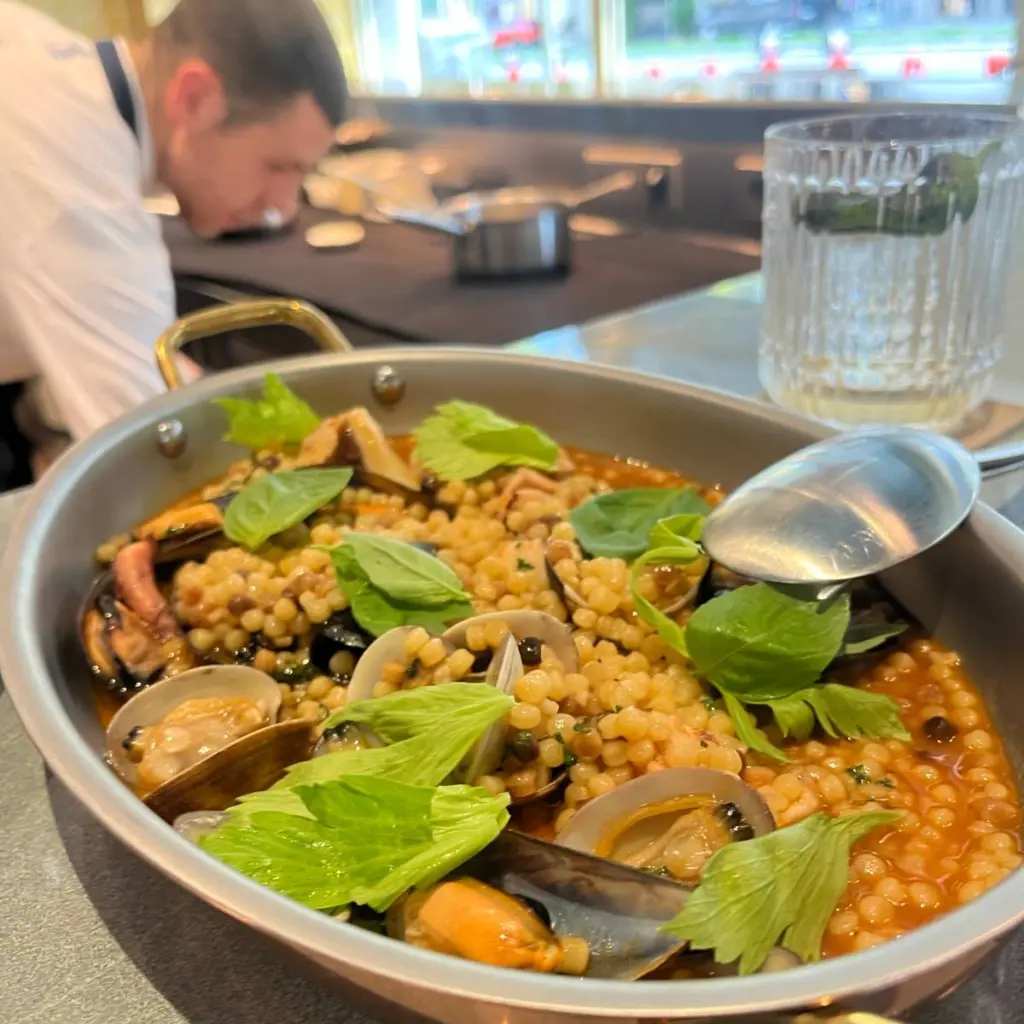
The true osteria spirit—that of a generous table—is best captured in the dishes meant for sharing. The standout here is Osteria Condal’s seafood fregola (€70), accompanied on the menu by wild-caught fish depending on market availability and a dry-aged beef T-bone with seasonal sides (€9.80 per 100 grams).
Those who prefer to leave the choice to the kitchen have two distinct options:
Frenesia Menu (€70): designed as a series of individual dishes, it features “carbonara”-style squid tartare, onion curd with mantis shrimp and salsify, linguine with tomato pilpil and clams (exclusive to this menu), and charcoal-grilled venison, before concluding with green shiso sorbet, tiramisu “airbag,” and petits fours.
Paral·lel Menu (€90): designed around the art of sharing, it begins with bites not found on the regular menu—a “pizza,” vegetable taco, shrimp and mató tartlet, rice and lobster supplì—followed by Iberian pork shoulder, stuffed calamari in its own juices, and seafood fregola; it lets you choose between red mullet or venison for the main course and finishes with shiso sorbet and rum babà.
The à la carte desserts maintain that same balance between Italian classicism, a nod to local flavors, and the spirit of the place: there’s a rum-soaked babà with light whipped cream designed for sharing (€18), a “mel i mató” with walnuts and miso ice cream (€14), a hot chocolate tartlet with vanilla ice cream (€16), and a green shiso, matcha, and sake sorbet (€14). However, the most symbolically significant dessert is the Airbag tiramisu (€14), an edible tribute to the legendary air baguette from the Tickets era.
Seventy seats, several distinct atmospheres
The restaurant seats 70 guests across rooms with distinct atmospheres, so the same dinner can feel more intimate or more lively depending on which table you’re seated at. That’s no small feat for a venue that was once conceived as a grand stage.
Among the design details, one gives a nod to the past: hanging over one of the areas are strawberry-shaped lanterns made of braided fiber, a tribute to the strawberries that adorned the ceiling of La Dolça back in the Tickets era. It’s the only explicit reference to the venue’s history in an interior that, otherwise, looks to the future.