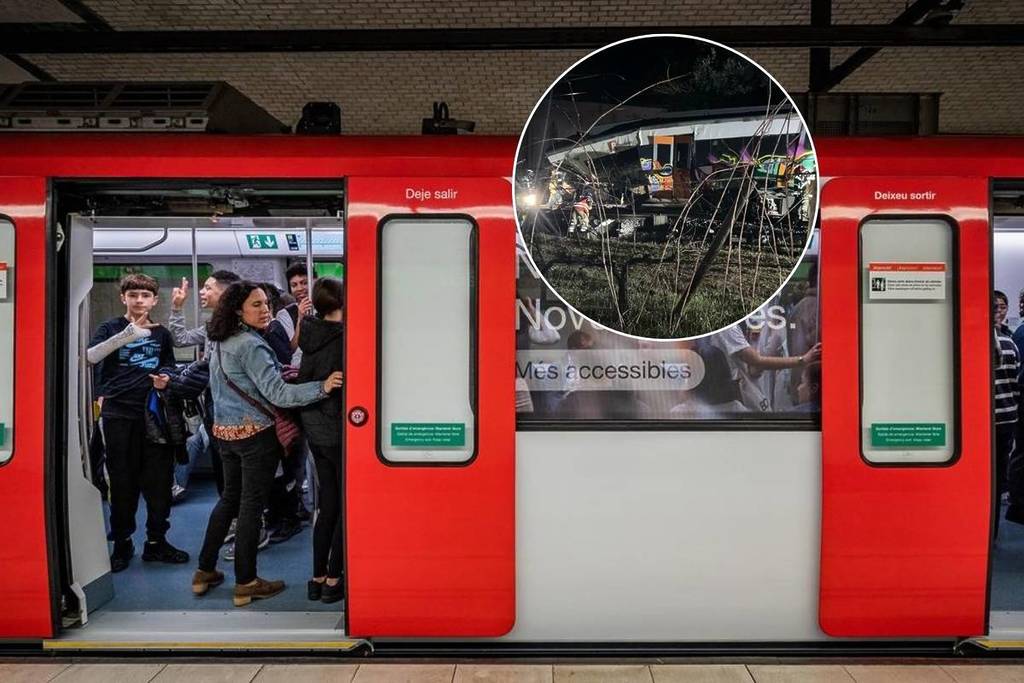
Following the fatal train accident in Gelida, the Rodalies network has been completely suspended throughout Catalonia, and the Catalan government has recommended using “alternative routes to travel around the region.” Adif is keeping all lines closed while it assesses the damage caused to the infrastructure by Storm Harry and yesterday’s incidents.
For those wondering how to get to the office or back home when the train decides that today is not its day, the key is to combine resources. The Catalan government and Renfe have already warned that, for the moment, there is no comprehensive replacement plan, and that they are working to reestablish the Rodalies service as soon as possible after reviewing the condition of all the tracks.
The Catalan government’s initial recommendation is to avoid travel as much as possible, especially if it involves the use of Rodalies or access to and from Barcelona.
But if you have no other option, we will tell you the main routes for entering, leaving, and traveling within Barcelona on this difficult day for mobility.
Additional buses and the road emergency plan
One piece of good news is that urban and interurban buses are operating normally and have become one of the main means of access and transport to Barcelona and within the city.
Given the scale of the disruption, the authorities have had to move quickly to try to prevent total collapse. One of the most significant last-minute measures has been to authorize regular bus line operators to use discretionary service reinforcement vehicles. In practice, this means that today we will see buses that normally provide private or tourist services helping to absorb the flood of passengers who have been left without their usual train service.
These intercity lines and the Exprés.cat network are now taking center stage. Companies such as Sagalés, Alsa, and Moventis are doing their utmost to connect Barcelona with cities such as Girona, Vic, and Garraf. Despite this extra reinforcement of vehicles, patience is still important as demand is extremely high and the roads are also feeling the increase in traffic from those who have decided to take their private cars.
The refuge of the Ferrocarrils and the Metro
Within the inner ring and the metropolitan area, TMB buses and the Metro have become, more than ever, the backbone of the city. TMB services are operating normally and are the best option for connecting key points such as Sants, La Sagrera, and Passeig de Gràcia.
However, the real lifeline for Baix Llobregat, Vallès, and the Anoia area is the Ferrocarrils de la Generalitat (FGC). Lines S1, S2, R5, and R6 are operational and are absorbing much of the flow that would normally travel on Renfe lines. If you live in cities such as Terrassa, Sabadell, or Manresa, the advice is straightforward: forget Renfe and head to the FGC stations.
However, throughout the morning, it has been reported that several metro services are experiencing an increase in passengers, with some stations particularly crowded.
Shared mobility and long distances
In light of the emergency, carpooling is no longer a money-saving option but a necessity. Mobility platforms and messaging groups are buzzing with users organizing themselves so as not to leave empty seats on their journeys along the C-31 or C-32. If you have to leave the city for more distant regions, long-distance services and high-speed trains (AVE, Ouigo, and Iryo) are still operating with some speed restrictions, and are the only reliable option for long journeys.
Getting around Catalonia today requires calm. The most useful tool you can have on your cell phone right now is the Generalitat’s ‘Mou-te’ portal, which provides real-time updates on door-to-door journeys combining bus, metro, and FGC. Leave with plenty of time to spare, especially if your route depended on the R1 or R4, and remember that today the shortest route is not necessarily the one marked by the GPS, but the one that has an alternative on wheels or on the Generalitat’s railways.
Open tolls and how to follow traffic conditions in real time
One of the measures most welcomed by drivers is the lifting of barriers at the Garraf Tunnels (C-32) toll. The Generalitat has decided to open the passage free of charge for the duration of the incident on Rodalies, thus providing a quick alternative by road for residents of Baix Llobregat and Garraf who are without their usual R2.
If you decide to take the road, Google Maps may not be enough today. For first-hand information and to avoid getting caught in unexpected traffic jams, the most reliable source is the official channels of the Catalan Traffic Service. Its interactive map of traffic incidents allows you to see in real time which roads are closed or where there are significant delays.
In addition, if you prefer the immediacy of social media, the X (Twitter) account @transit is where the latest alerts, accidents, and lane opening or closing notices are posted. Checking it before you start your car can save you more than one headache, especially on the Diagonal and Gran Via, which are expected to be more congested than usual today.