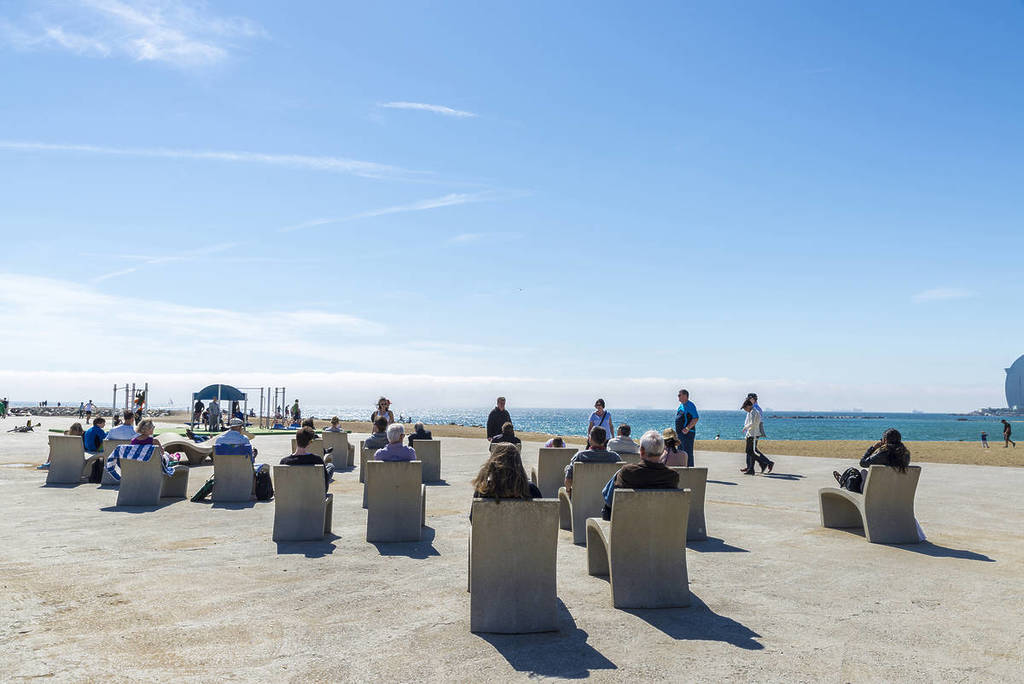

The city’s asphalt seemed to be melting under the relentless sun this past Wednesday, on a day when the atmosphere grew thick and the air offered little respite even on street corners. This was not merely a subjective perception among residents: Catalonia experienced the most extreme day of the current heat wave, recording a veritable avalanche of all-time high temperatures that set unprecedented records from the Barcelona coast to the Ebro region.
In light of this exceptional situation experienced on July 8, the Catalan Meteorological Service has decided to extend the high-temperature alert until next week. Although the State Meteorological Agency expects the widespread heatwave to end nationwide this Thursday, extreme heat will persist in the Catalan regions following a very brief drop in temperatures, which will then rise sharply again heading into Sunday.
More than a century of history surpassed at Tibidabo
The city of Barcelona experienced a historic moment in terms of weather when it recorded 40.9 °C at the manual station of the Fabra Observatory, surpassing the previous record of 40 °C—set on July 30, 2024 —by nearly one degree . Meanwhile, the automatic station at the same observatory came very close, recording a sweltering 40.7 °C on Wednesday afternoon.
This Tibidabo site is a true climatic treasure trove with a historical record spanning 112 years, dating back to 1914. For Javier Martín Vide, director of the Fabra Observatory, the fact that such a long-standing record has been broken twice in just two years is a cause for concern that, as he explained, should compel society as a whole to reflect on the issue.
A map of records from the coast to the Ebro River
The Catalan capital was not alone in this rise in temperatures. The hottest spot in all of Catalonia was in Vinebre, in the Ribera d’Ebre region, where thermometers soared to 44.1 °C, surpassing the 43.8 °C recorded in August of last year within a historical record series that began in 1998. Aleix Serra, a meteorologist with the Catalan Meteorological Service (SMC), noted that the majority of these new record highs were concentrated particularly in coastal and near-coastal areas, affecting regions such as Barcelonès, Baix Llobregat, Garraf, Penedès, Tarragonès, and Alt Camp.
Data collected at stations that have been in operation for more than a quarter of a century confirm the magnitude of the event. In Ascó, temperatures reached 42.3 ºC, while Sant Pere de Ribes and Nulles both recorded a high of 40.4 ºC. Close behind were Sant Martí Sarroca at 40.3 °C, Constantí at 39.5 °C, Vila-rodona at 39.3 °C, and Vilafranca del Penedès at 39 °C. Even in coastal areas such as Cunit, the thermometer registered an unusual 37.6 °C.
Unbearable nights and a warning that drags on
The sweltering heat showed no sign of letting up as the sun set, resulting in what is technically known as a “hellish night,” as the low temperatures did not drop below 30 ºC. The most extreme example was recorded at the Portbou-Coll dels Belitres station, where the low temperature on Wednesday night was 31.9 ºC, making it the hottest night ever recorded in Catalonia. This figure surpasses the previous nighttime record set by the Fabra Observatory in Barcelona in 2019 (31.2 ºC) and that of the Portbou station itself in 2023 (30.3 ºC).
Given this outlook, Catalan meteorological authorities will keep the warnings in effect. Santi Segalà, head of Forecasting at the SMC, explained that although the heat will ease slightly in some areas on Friday and Saturday, the likelihood of exceeding risk thresholds remains a possibility, especially in areas such as Ponent. Segalà clarified that since this is such a short-lived drop in temperature—and given that temperatures will rise again on Sunday—it is considered part of the same heat wave. The areas that will continue to record the highest temperatures will be the Pla de Lleida, the Ebro regions, and various parts of central Catalonia.
The situation in the rest of the country
Nationwide, the Aemet has declared this second heat wave of the summer over as of Thursday after five days, due to the onset of a drop in temperatures across the southwestern part of the peninsula. However, Rubén del Campo, a spokesperson for the agency, warned that nearly half of Spain will continue to see temperatures above 35 ºC, and even as high as 38 ºC to 40 ºC on Saturday in central and eastern Spain and the Balearic Islands.
Del Campo also noted that the risk of wildfires will remain at very high or extreme levels across most of the country over the next few days. This July is continuing the trend set by an extremely hot June, and according to Aemet forecasts, the first half of the month is on track to become the hottest since records began in 1961, surpassing the previous records set in 2015 and 2022. As an example of this nationwide trend, the San Fermín festival in Pamplona recorded its hottest day on record last Tuesday, with a temperature of 41.4 °C. For now, Catalonia and nine other autonomous communities remain under an orange alert due to temperatures that will still range between 39 °C and 42 °C in inland areas and river valleys.