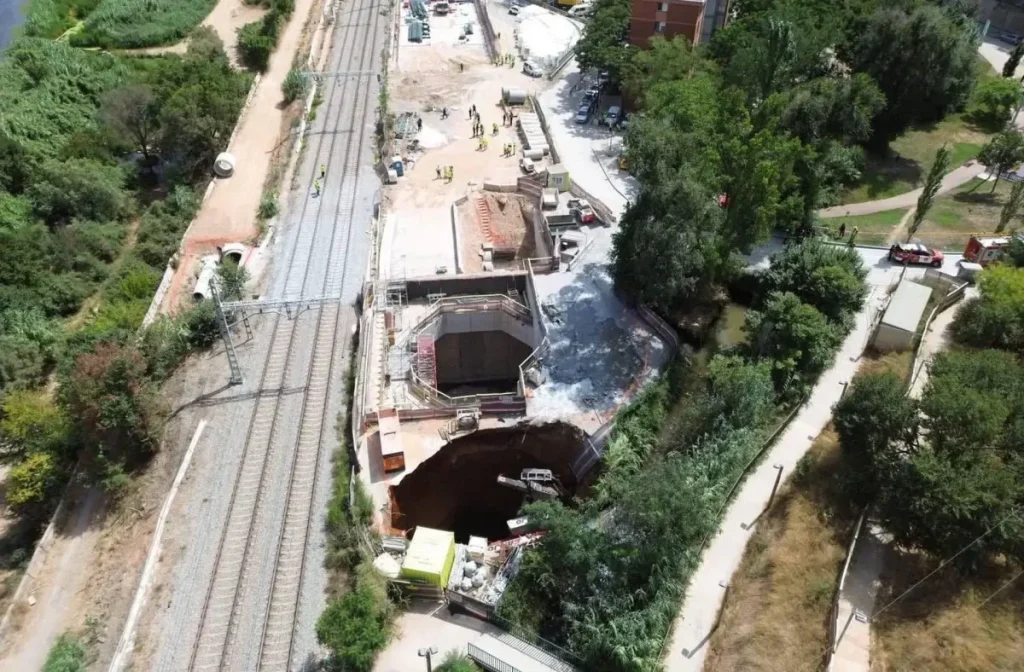

The wounds that sometimes unexpectedly open up in the ground of our neighborhoods take a long time to heal, especially when they swallow everything in their path. Four days after the ground gave way unexpectedly at the Montcada i Reixac underground construction site, rail service resumed early this Sunday with the reopening of Rodalies’ R2, R2 Nord, and R11 lines.
The massive hole, which forced service to be suspended since last Wednesday near the Vallbona neighborhood, required an emergency race-against-the-clock operation. After successfully filling the gap and conducting what are known as “test runs”—trial runs without passengers on board to ensure safety—on Saturday afternoon, Renfe was able to reopen the route for trains to continue to their destinations.
A crane buried deep underground
The scale of the collapse has produced figures and scenes that are hard to imagine in an urban setting. The ground collapse left a hole about 17 meters deep and 19 meters in diameter next to the shaft where the future rail tunnel is set to begin.
The force of the landslide swept everything in its path down into the depths. A large crane, several generators, and a workers’ shed were swallowed up by the earth and will remain there: they have been buried forever under the concrete. To seal this enormous hole, workers had to pour 365 cubic meters of concrete and 1,930 cubic meters of mortar.
Speed limits and underground monitoring
Although service has resumed, we cannot yet speak of a return to complete normalcy. Renfe has confirmed that all trains passing through the affected area will have to temporarily reduce their speed as a precautionary measure.
Meanwhile, Adif is maintaining a constant monitoring system in the area. Since the incident occurred, the company has taken daily measurements, confirming that “there has been no movement or alteration of the ground whatsoever, neither on the track bed nor in the structures of nearby buildings.” The cause of this collapse is still under investigation, although technicians point to the delicate nature of the subsoil in this area, which is heavily influenced by the waters of the Baix Besòs aquifer and the proximity of both the Besòs River and the historic Rec Comtal.
The R3 is running at half speed for another reason
As if the situation in Montcada weren’t enough, R3 passengers were also left without trains on Saturday, though for a very different reason: yet another copper theft.
By Sunday morning, service between L’Hospitalet and Fabra i Puig had already resumed, though with delays exceeding half an hour. For those who need to travel further, between Fabra i Puig and Puigcerdà, the only option for now remains an alternative bus service. This setback is not new to the network, as half of all thefts of this type of equipment in all of Spain occur in Catalonia, leaving thousands of regular commuters stranded on the platform.