
One of the most common problems we face when looking for a travel destination is a lack of time and the need to see everything. Wanting to make the most of the opportunity and not miss a thing often turns out to be a more stressful experience than a relaxing one.
Luckily, there are places that make everything easier for us and are so spectacular that it’s worth planning a getaway just to enjoy them.
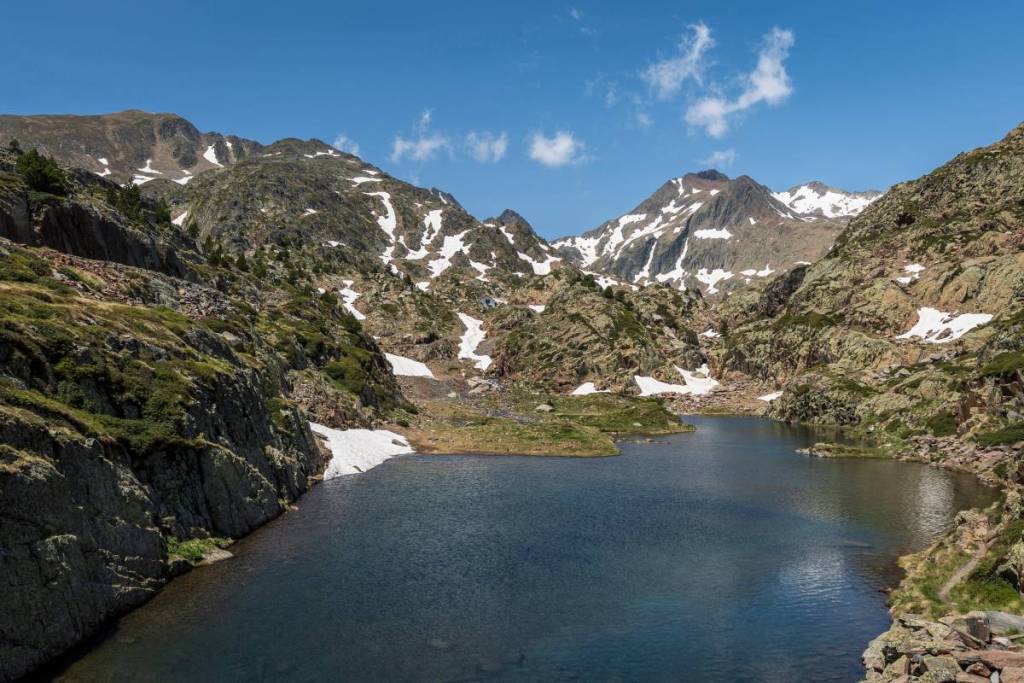
Can you imagine a lake at an altitude of nearly 3,000 meters from which to view Catalonia’s largest nature reserve? It exists—it’s about 200 kilometers from Barcelona and is known as the Estany de la Conca Gelada.
This place, hidden among the cliffs of the Pyrenees, is also one of the best-kept secrets among mountaineers and hikers, as it sees very few tourists. Although it’s true that access isn’t easy, and the trails leading to this spot aren’t suitable for beginners.
This glacial lake is the highest in all of Catalonia and offers up-close views of the region’s highest peak: the Pica d’Estats. It’s located in the Alto Pirineo Natural Park, the region’s largest protected area, where you can take in movie-worthy landscapes and spot dozens of native species.
How to Get There and Camping Rules
Another plus is that camping is allowed by the lake, although the restrictions and rules are very specific, and it’s a good idea to review them carefully before spending the night here: you can only stay one night, and you can only set up your tent or bivouac between 8:00 p.m. and 8:00 a. m. the following day. Also, if you’re a group, the limit for small tents is three; if you need more, you’ll have to apply for a special permit.
Thanks to the altitude and the fact that it’s virtually untouched wilderness, light pollution is nonexistent, and you’ll be able to enjoy unbeatable views of the starry sky. But this also means that access is quite challenging: the best way to get there is to leave your car at the Molinassa parking lot (at an altitude of about 1,800 meters) and hike the rest of the way to the lake.
But don’t forget that this is a very difficult hike for inexperienced hikers, and it can take more than 9 or 10 hours to reach the lake. Ideally, you should plan your route thoroughly and bring only the essential gear.
The Smugglers’ and Fugitives’ Trail
Although you won’t find any records or explanations about this area’s past, the truth is that, due to its proximity to the French border, it has historically served as a route for smugglers and fugitives .
These routes were particularly significant during the 20th century as they served as a passageway for migrants during the Spanish Civil War and later during World War II. So, who knows—you might even find a relic or a lost object that’s decades or even hundreds of years old.