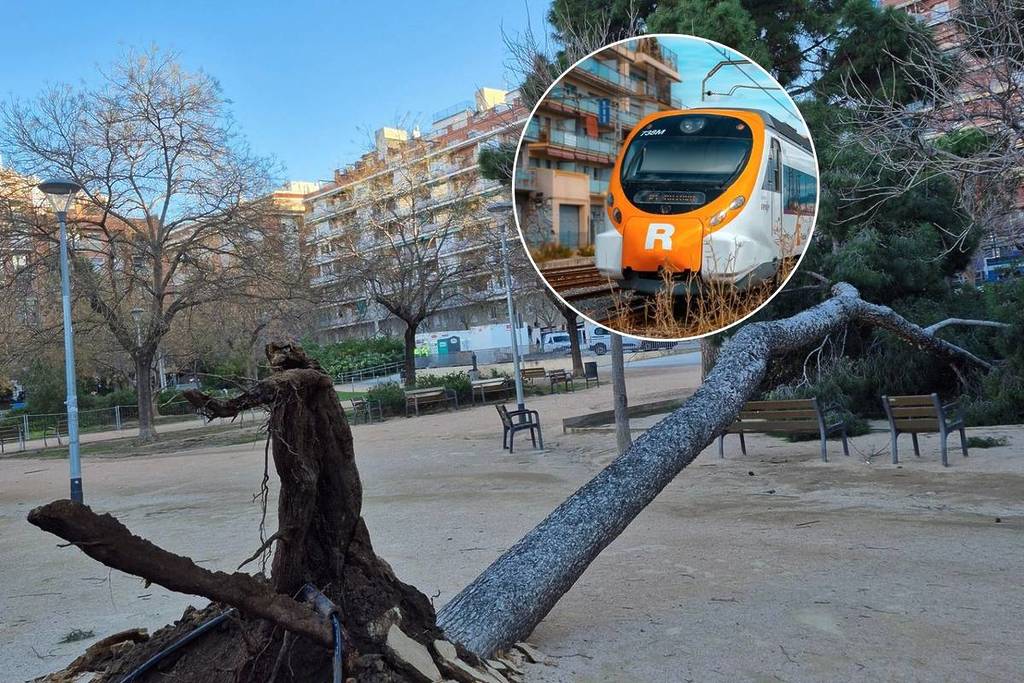
Getting around Barcelona and its surroundings today will require an extra dose of patience and, above all, checking the information screen before leaving home. The severe windstorm battering the region has put rail mobility in check, forcing the authorities to take preventive measures to ensure passenger safety. Although the initial intention of the Regional Ministry of the Interior was to maintain normality, the reality of the weather is already leaving its first scars on the transport network.
Minister Núria Parlon has confirmed that, following a meeting with Territori, Adif, and Renfe, the Rodalies and Ferrocarrils de la Generalitat (FGC) services will remain active throughout the day. However, this “normality” comes with a caveat: speed restrictions have been imposed at various critical points and so-called “white runs” (trains without passengers running to check that the tracks are free of obstacles) are being carried out before commercial trains are allowed to pass.
Incidents and sections affected by the wind
Despite preventive efforts, the wind has already caused the first serious incidents. Fallen trees on the infrastructure have forced the temporary suspension of traffic on several key sections during the early hours of the morning. Among the most affected lines are the R1, with cuts between Blanes and Maçanet; the R11, on the section between Girona and Maçanet; and the R4, which has suffered interruptions both to the north, between Terrassa and Manresa, and in the metropolitan area between L’Hospitalet and Molins de Rei.
Although some of these sections have gradually resumed activity, the situation remains unstable. According to the Servei Meteorològic de Catalunya (Meteocat), wind gusts could exceed 70 or 80 km/h in coastal and pre-coastal areas, keeping Adif’s maintenance teams on high alert. They have reinforced their presence on the tracks to intervene immediately in the event of any emergency.
Stations closed for safety reasons
The most notable breaking news is the preventive closure of three key stations. Renfe has decided to close the stops at Premià de Mar, Malgrat de Mar, and Barberà del Vallès. The reason is none other than structural risk: strong gusts of wind threaten to detach part of the platform canopies, posing a direct danger to passengers.
To try to mitigate this disruption, an alternative road service has been set up to cover travel between Pineda and Blanes, as well as the section from Ocata to Vilassar. It is a drastic measure, but necessary in the face of a relentless storm, and aims to prevent accidents caused by damage to infrastructure.
How is the wind affecting the Barcelona-Madrid AVE high-speed train?
Unlike the Rodalies network, the high-speed network is proving to be more resilient to the storm. According to Adif, commercial service on the AVE, Avlo, Iryo, and Ouigo trains between Barcelona and Madrid is not being directly affected by the gusts of wind from Storm Nils. High-speed lines are designed to withstand more severe weather conditions, and so far, there have been no reports of suspensions or extraordinary delays due to the weather in this corridor.
However, it should be noted that the line already has a structural delay of around 25 minutes on average due to speed restrictions imposed by Adif following the Adamuz accident in January. Therefore, if your train is running a little late, it is most likely due to these preventive infrastructure checks and not to today’s gale.
A new protocol on the horizon
This management of the service under adverse weather conditions comes at a particularly sensitive time for Catalan public transport. Following recent incidents caused by heavy rain, such as the tragic collapse of a wall in Gelida, the regional government is working on the creation of a specific protocol for extreme weather events. The aim is to unify criteria for deciding when it is strictly necessary to suspend traffic as a preventive measure, something that FGC already applies internally but which Rodalies seeks to standardize.
For those who have to use the bus as an alternative on sections where the train does not run due to works or breakdowns, the recommendation is the same: extreme caution. Replacement bus services are also subject to the instructions of the Mossos d’Esquadra, who may order technical stops if road conditions become dangerous. In short, today is a day to travel only if necessary, and if you do, expect that the clock will not be your best ally.