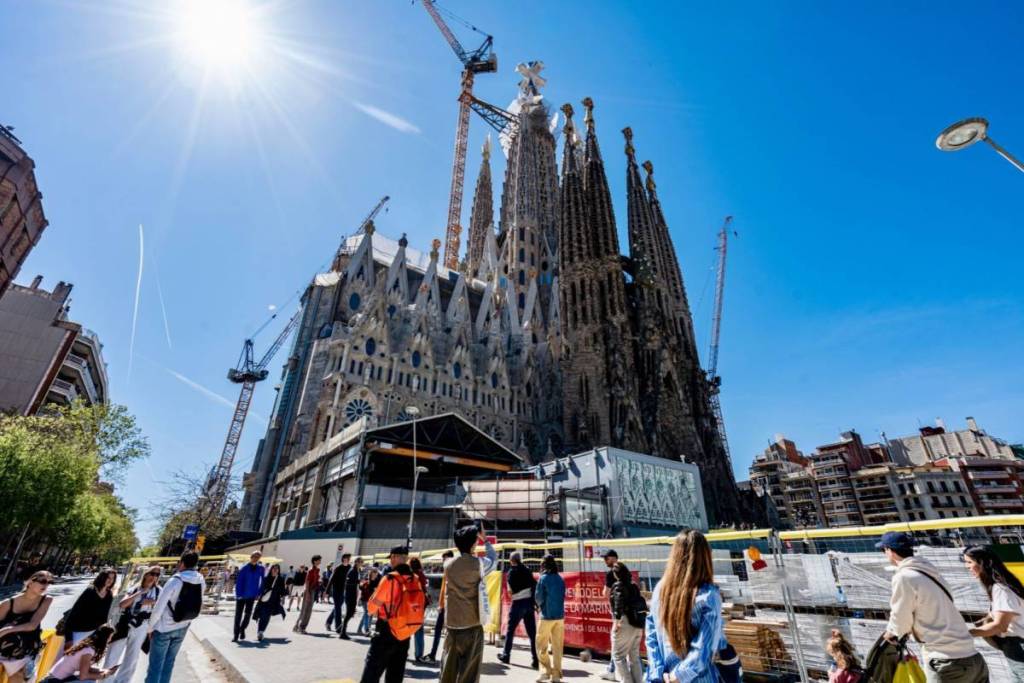

No one can dispute that the Sagrada Família is one of the greatest monuments in history, a candidate to become one of the Seven Contemporary Wonders of the World, and a work of unprecedented grandeur. But such beauty comes with unparalleled technical complexity, and although the most optimistic estimates suggest that construction could be completed in about ten years, problems and challenges continue to arise in the effort to bring Antoni Gaudí’s ambitious dream to fruition.
One of these problems relates to the construction of the grand staircase. The Construction Board has yet to finalize and agree on the definitive design with the Barcelona City Council. Yesterday, Tuesday, September 22, the Board’s general director, Xavier Martínez, announced the possibility of establishing a “minimum project” that would require demolishing the Núñez y Navarro block, preserving almost the entire surrounding area and enclosing the staircase within a structure.
But a few hours later, they issued a statement clarifying that while the demolition of this building is absolutely necessary, the construction would affect other properties in the area—specifically, all those extending as far as València Street. Neither option would fulfill Gaudí’s original plan, which would require razing two entire city blocks, from Mallorca Street to Aragó Street, to clear space for a large, monumental plaza.
The City Council’s Response and the Residents’ Uncertainty
The city government has already announced that it will opt for the option that causes the least possible disruption to residents in order to protect the right to housing, and it expects a final design to be presented in the coming months.
Although the authorities are in constant negotiations with the affected residents—and the goal is for them to be able to continue living in the same neighborhood—the uncertainty over which buildings will be demolished and which will not has been affecting them for more than 50 years.
The basilica has offered to relocate them to a plot of land it owns on Mallorca Street, but depending on how many people request relocation instead of monetary compensation, the new site may not have sufficient building rights.
Lack of permits and uncertainty regarding the artistic design
Aside from the issue of the staircase, there are two open questions regarding the next steps in the project: the cantilevers and porticos, which would encroach on street space where the basilica lacks a building permit, and the uncertainty surrounding the design of the Glòria façade. The Construction Board has not yet selected who will design that part of the monument and has requested more time to choose the artist in charge.
Meanwhile, interior work is progressing, and the interior of the Tower of Jesus and the Chapel of the Assumption are expected to be completed in 2028. At the same time, the four new towers of the Glòria facade will be built, rising to a height of 120 meters.