
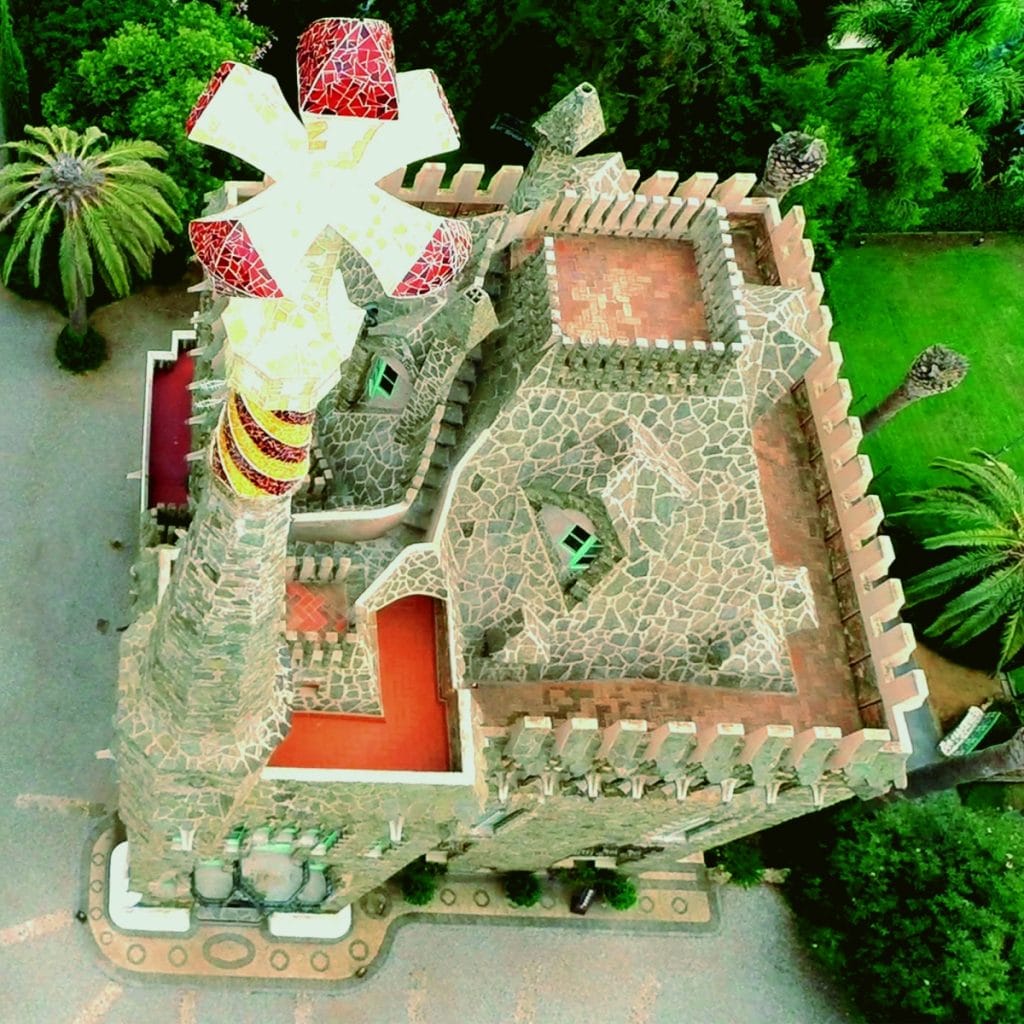

There are corners of the city that seem to remain silent on purpose, hiding stories carved in stone far from the main tourist routes. We’re talking about the Bellesguard Tower, a gem built on the street of the same name between 1900 and 1909, commissioned by Jaume Figueras, which blends the spirit of Modernism with echoes of a Neo-Gothic past.
Built directly on the ruins of the former refuge of Martin I the Humane—the last Count of Barcelona—this fortress remained hidden from the view of local residents until 2013. Its history took a major turn last year, when the Catalana Occidente group paid 30 million euros to acquire the estate, taking over from the Guilera family, who had been its guardians without interruption since 1944.
The Betrayal of the Curved Line
“The straight line belongs to man; the curved line belongs to God.” This maxim, attributed to Antoni Gaudí, is the guiding principle that underpins nearly his entire legacy. His work rarely allows for straight lines, but the Bellesguard Tower is the great exception to the rule. In a way, it is the project in which the architect contradicts himself and betrays his own ideals, setting aside the organic silhouettes to which he has accustomed us to embrace a much more rigid and earthly geometry.
The building’s design straddles the line between full-fledged Modernism and the Neo-Gothic style of his early career—a period that also influenced other local works of his, such as the Celler Güell and the Teresianas School. However, the true inspiration behind its façade is purely medieval: the structure pays an undeniable tribute to the old stately castle that once dominated that very same plot of land centuries ago.
For nearly seven decades, the interior of the tower remained a complete mystery to the people of Barcelona. The Guilera family kept the residence strictly private until, in 2013, the need to finance various repairs to the site forced them to finally open its doors to the public. That period of public access culminated in the recent multimillion-euro sale, closing yet another chapter in the history of the Modernist genius’s most unconventional work.
