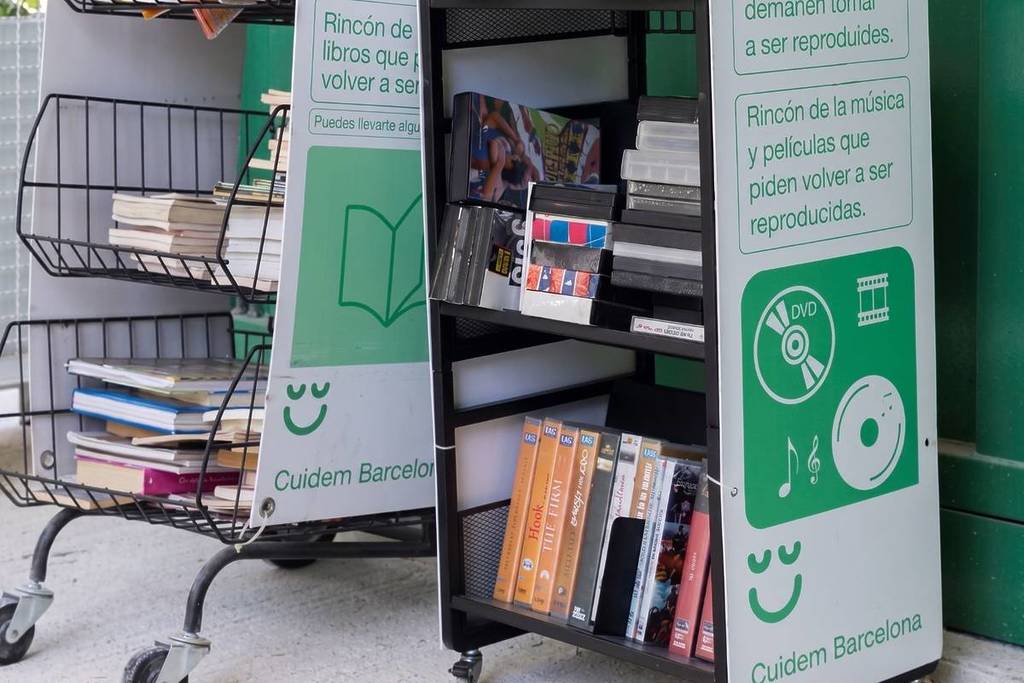

Barcelona has launched a new free music and movie exchange service at four Punts Verds de Barri (PVB) locations.
The facilities in Poblenou, Vallcarca, Fort Pienc, and Sants are the first to incorporate this space, where residents can drop off and pick up original CDs, DVDs, and vinyl records (with original covers and no burned copies) free of charge.
Each person may take up to three items per day, a limit that can be increased if they also donate similar media.
The project launches in April as a six-month pilot program, during which the City Council will assess its impact to decide whether to extend the service to the rest of the city’s network of recycling centers.
A model already tested with books and toys
The initiative follows the model of two established services housed in the same facilities. The Book Corner, active since 2010, recorded more than 158,000 users in 2025, with 375,000 books deposited and 266,000 checked out, and helped prevent more than 212,000 kilograms of paper waste.
The toy corner, developed in collaboration with the Fundació Formació i Treball, prevented more than 66,000 kg of waste in the same year.
Some of the selected items are distributed to vulnerable families through the social services network; the rest are sold at the foundation’s secondhand stores at reduced prices.
Vinyl records, beyond conventional recycling
The new service also addresses a specific technical need. In 2025, Barcelona’s recycling centers collected 34 tons of CDs and DVDs, which were sent for recycling.
Vinyl records, however, cannot be processed through the conventional recycling system and, until now, ended up being discarded.
Exchanges between individuals extend the items’ useful life without additional environmental impact.
The measure falls under European Directive 2008/98/EC and Spanish Law 7/2022 on waste and contaminated soil for a circular economy, which prioritize prevention and reuse over final waste management.
A network of 134 locations throughout the city
Barcelona has 134 recycling points distributed among neighborhood, area, and mobile facilities: 27 PVBs, 100 mobile recycling point stops spread across the ten districts, 7 area recycling points for larger-volume waste, and a mobile school recycling point intended for educational workshops.
87% of the waste collected at these facilities was recycled, 9% was reused, and the remaining 4% was managed as special waste.