Gastronomy is much more than just putting a piece of food in your mouth. It has always been much more than eating. It is a social act, a ritual. And in the heart of the Sant Antoni neighborhood, right in the basement of its emblematic market, this maxim is taken to a whole new level. We are talking about the Cuina Comunitària de Sant Antoni, a project that has demonstrated in little more than a year that pots and pans are the perfect tools for sewing the social fabric.
What began as a neighborhood demand during the remodeling of the market has been transformed into a vibrant meeting point managed by the Federació d’Entitats de Calàbria 66. And while the space is perfectly equipped with worktops, stoves and even a cold room, technician Carme Viñeta sums it up perfectly with a sign: “The kitchen is the excuse”.
More than cooking workshops: a universal language
Unlike a civic center or a professional bakery, the goal here is not to train chefs or produce large quantities. It is to use the act of cooking and eating as a “common and universal language” that appeals to everyone, as Marc Folch, a technician at Calàbria 66, points out.
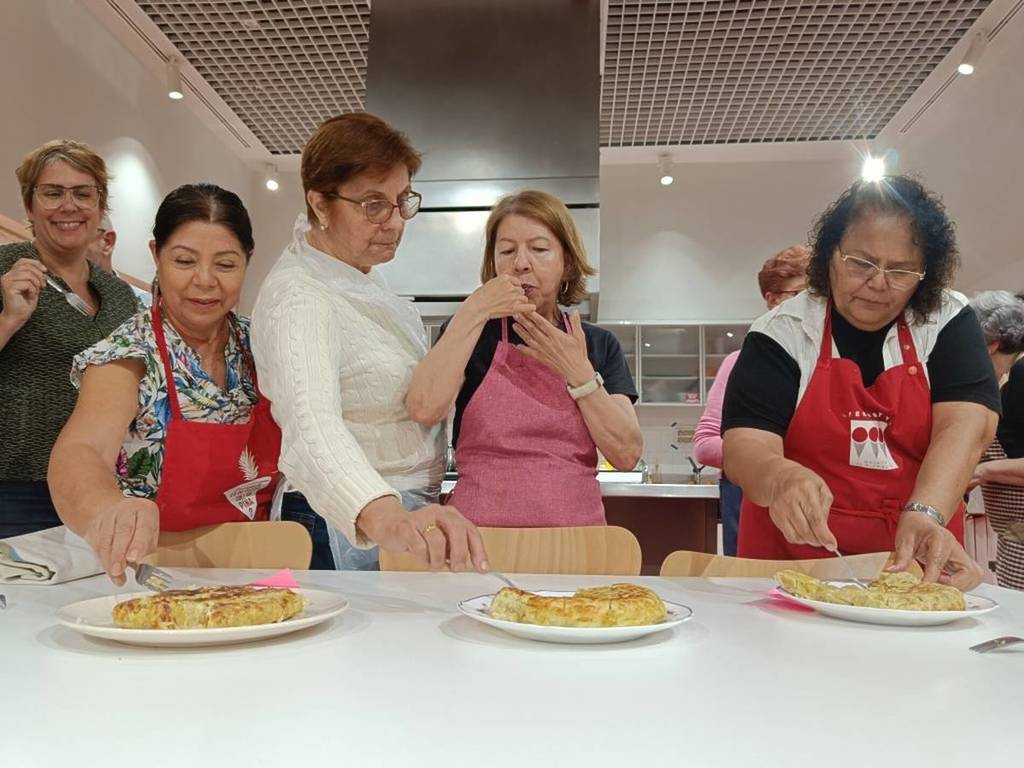
The result is a kaleidoscope of activities that already brings together more than forty neighbors on a regular basis. For example, Mari Carme, who got hooked after a workshop on healthy eating for the elderly, or Flora Alba and Iliana, who found in the space the opportunity to practice Catalan, make friends after moving to the city and, most importantly, get out of the house and break the isolation.
Around the table and the picador, solutions to housing problems have been found, valuable intergenerational interaction has been fostered and even barriers around mental health have been broken down, as participants from the Servei de Rehabilitació Comunitària and other neighbors without a diagnosis have shared the space.
From the fight against waste to neighborhood ties
The heart of the project beats strong in initiatives such as the Cuina Oberta, where groups of retirees and neighbors meet every Wednesday to decide and prepare seasonal recipes. But it goes much further:
-
Aprofita’m: In collaboration with the NGO De Veí a Veí, surplus food is collected from neighborhood businesses to cook menus for vulnerable groups, thus fighting food waste while encouraging volunteering and participation.
-
Cuinem Junts: A monthly activity that invites families with children to cook together, ensuring the generational relay and the transmission of habits.
-
Collaboration with the Market: The space is used for projects such as “The school cooks in the market”, where students learn about food by buying directly from the stallholders before cooking it.
The impact is so positive that Cuina Comunitària is already charting new paths. From the design of a new space to promote interculturalism through gastronomy, avoiding exoticism to bring together the diverse realities of the neighborhood, to the expansion of activities such as ‘Cuinem junts’ and collaboration with urban gardens in the neighborhood.