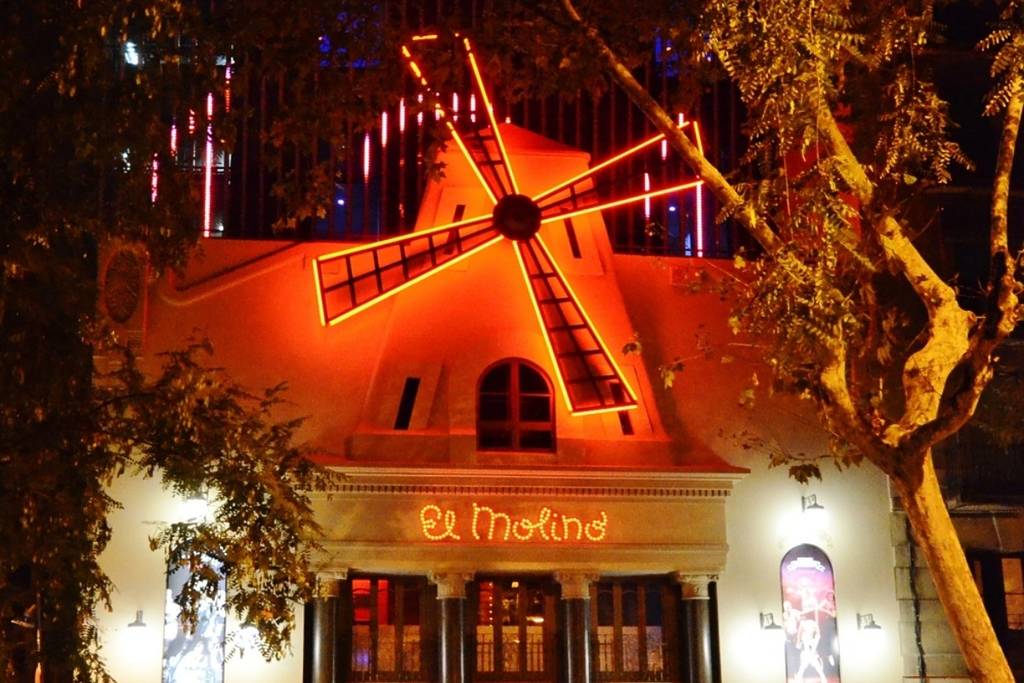

If there is one feature that defines the Barcelona nightlife skyline, it is the red blades crowning the Paral·lel. However, it seems that this summer the movement will come to a halt once again. El Molino, that temple of cabaret that has survived censorship, crises, and turn-of-the-century changes, will close its doors on June 30. The news comes following a “mutual agreement” between the Barcelona City Council and Barcelona Events Musicals (BEM), the company linked to the Cruïlla festival that took over the venue in October 2024.
The decision was not a sudden impulse, but the result of a mix of technical complications and neighborhood relations. In recent months, the theater has had to deal with significant restrictions on operating hours and capacity due to noise complaints, which forced it to limit shows to weekends and end the festivities before 11:00 p.m. A situation difficult to sustain for a venue that was created to be, precisely, the epicenter of revelry and live music.
A necessary silence to sound again
The key to this hiatus lies within the venue’s own walls. The city council has decided it is time to carry out definitive soundproofing work to ensure that, when the blades start spinning again, they do not wake up the entire neighborhood. A detailed design is currently being developed as a preliminary step before the construction project goes out to bid. The idea is not simply to fix some cables or add more foam to the walls, but to establish the venue as a premier cultural facility on an avenue that the City Council aims to revitalize with a multi-million-euro investment through 2028.
While the machinery arrives, the immediate future of number 99 on Paral·lel remains up in the air. There is no official reopening date, but the city’s intention is for the theater to remain public and retain its essence. In this latest phase, under BEM’s leadership, El Molino had transformed into a small-scale club where jazz, flamenco, and singer-songwriter music had taken over from sequins, seeking a more international vibe similar to clubs in London or New York.
A born survivor since 1898
This isn’t the first time El Molino has given us a scare. Since it opened in 1898 as “La Pajarera Catalana,” it has gone through all sorts of names and crises. It closed in 1997, leaving a huge void in the city’s sentimental memory, and it wasn’t until 2010 that it once again lit up the street with the show Made in Paral·lel. After a somewhat turbulent management period by the company Ociopuro, the City Council purchased the building in 2021 for 15 million euros to prevent it from being turned into anything other than a cultural venue.
Although the June 30 closing sounds like a farewell, history tells us that El Molino always finds a way to reinvent itself. Until that last day of June arrives, the venue will maintain its usual weekend schedule, so there’s still time to have one last drink under the gaze of Bella Dorita and trust that, this time, the silence is merely the prelude to a better show.