The Expiatory Temple of the Sagrada Familia is, without a doubt, Antoni Gaudí’s masterpiece and the most unmistakable symbol of Barcelona. It is a box of secrets, religious symbolism and architectural wonders, but it also hides, it seems, a less mystical and much more mundane story: a big miscalculation, one of those that hurt. An error in the layout that resulted in the asymmetry of the bell towers of the Nativity façade, and which Gaudí simply did not care about.
This curious anecdote, which removes iron from the image of the architect (and the church) as an infallible being, has been pointed out in a thread by the tweeter Efemèrides d’Arquitectura (@efememarq), and explains that it is known thanks to the memories of one of his closest collaborators and one of the great figures of the recent cultural history of Barcelona: the Catalan artist and painter Ricard Opisso.
The mystery of different distances

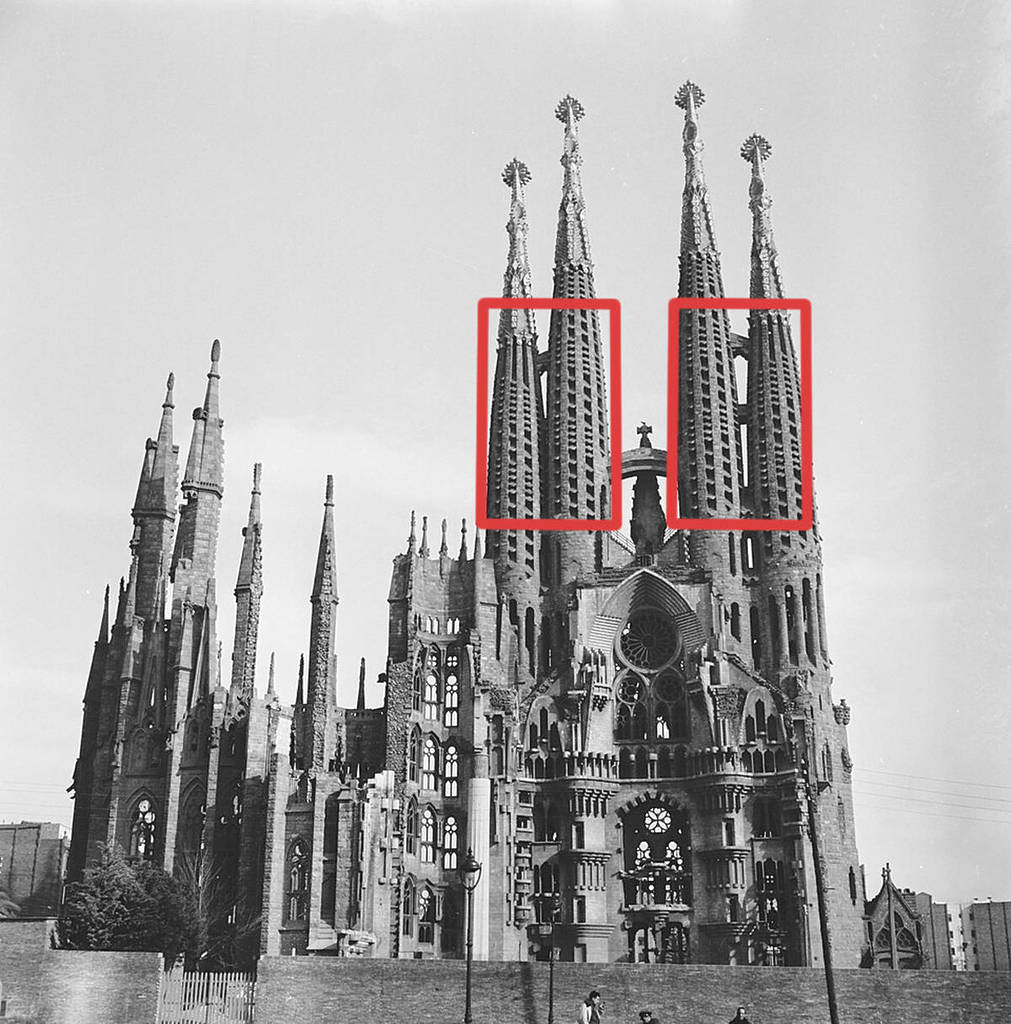
The Nativity façade, the first to be completed, is crowned by four bell towers. If one looks closely, the two bell towers on the left side are closer together than the two on the right side. A subtle, but undeniable, asymmetry.
For a long time there was speculation as to whether this irregularity responded to some kind of theological message or to a hidden symbolism inherent in the complexity of the work. However, Opisso dispelled the doubts in his biographical notes. The cause of the disparity of distances is none other than a “mere screw-up”, a textbook technical error: a failure in the re-staging. Staking out is the process of capturing to real scale on the ground what is drawn on the plan, and it was there, at that crucial moment, where the master builder made the mistake with the distances.
The most surprising part of this story is not the mistake itself, but the reaction of Gaudí himself when he detected it. As Opisso recounted, the Catalan architect showed a capital indifference, a lack of interest that many would find incomprehensible. The draftsman remembered Gaudí as a mercurial man, with a singular character, with that “blue-eyed, penetrating and terrifying gaze” that made him draw a portrait that he himself considered the most authentic.
The key to his indifference can be found in a dialogue that Opisso witnessed, where the architect Antoni Maria Gallissà asked Gaudí about the reason for the unequal separations between the bell towers. The genius’s answer was emphatic: “after all, it was of no importance, given that this irregularity of distances is also observed in the Parthenon itself, where the separations between column and column are never equal.”
In fact, since the Nativity façade was not symmetrical,the Passion Façade, built later, had to follow the same asymmetrical pattern to maintain the structural logic and unity of the transept. The big question now is what will happen with the Façade of Glory, the main one, which according to its structure seems to point to symmetry.
Who was Opisso, the assistant who revealed the error?
Opisso, born in 1880, began working with Gaudí when he was only 12 years old and was a privileged witness of his life and the evolution of the work until 1904. His testimonies are today a key source for understanding the personality and modus operandi of the master.
His life was always linked to art and illustration, he was much more than Gaudí’s assistant on the scaffolding. As an illustrator, he left a vast legacy in the press of the time, working in publications such as L’Esquella de la Torratxa, La Campana de Gràcia or the legendary Madrid humor magazine Blanco y Negro.
His work is marked by costumbrismo, humor and an elegant stroke, becoming a visual chronicler of the bohemian atmosphere of Barcelona, especially at the time of Els Quatre Gats. His memoirs, which allow us to approach the most human and less divinized Gaudí, are a treasure to understand a crucial fragment of the history of the city.