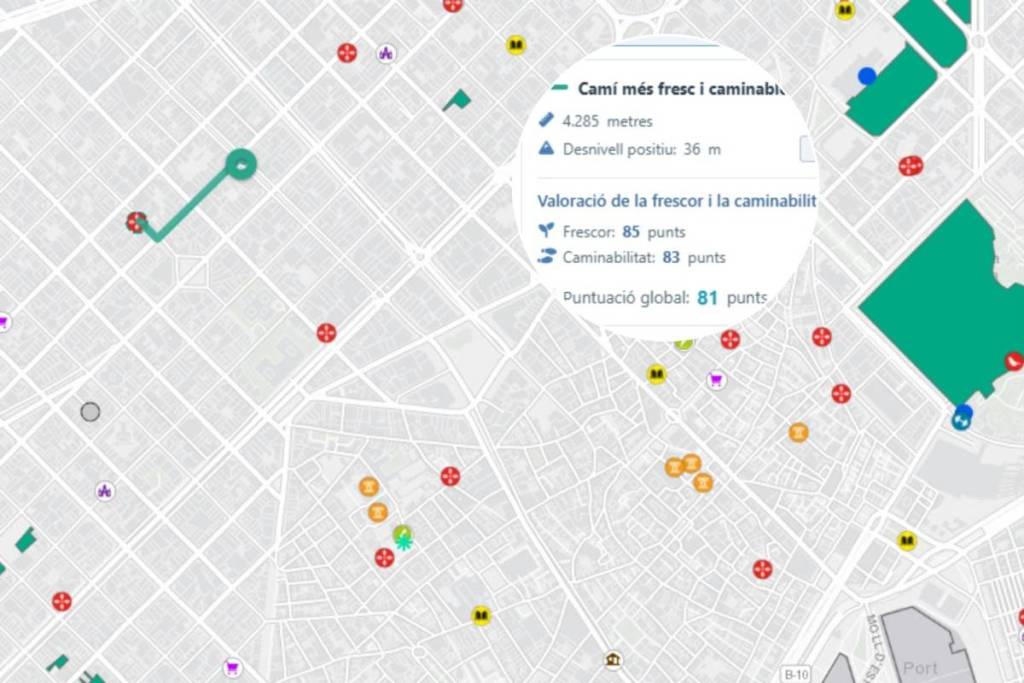

When the sun beats down and the asphalt seems on the verge of melting, crossing the city on foot becomes a real survival challenge. We’ve all instinctively taken a detour at some point, seeking shelter under a row of trees or on that sidewalk that, simply by its orientation, has already earned the benefit of shade. Now, that instinct for urban survival has been transformed into useful technology thanks to the new app launched by the Barcelona Metropolitan Area (AMB).
Dubbed a sort of “anti-heat GPS,” this tool doesn’t seek the shortest route between two points, but rather the coolest and most pleasant one for pedestrians. To achieve this, the system maps out walking routes that prioritize the least sun-exposed streets, seeking out shaded areas—especially those provided by trees—and selecting sections with wide sidewalks, minimal elevation changes, and low traffic volume.
The Science Behind Shade
The difference between choosing the right or wrong street to walk down can be measured in degrees. A field test conducted in Sant Feliu de Llobregat, along a route connecting the Montserrat Roig Library to Europa Park, demonstrated how the ground we walk on can either make our steps more difficult or easier.
The data leaves no room for doubt: artificial pavement in direct sunlight reaches a sweltering 50 ºC, but if that same artificial surface is in the shade, the temperature drops to 36 ºC. The ultimate oasis for a pedestrian’s feet is found on natural pavement protected by shade, where the thermometer barely registers 29 ºC.
For now, this cooling navigation tool is available only as a web version. However , Lacort reveals that the project will take a major leap forward starting in 2028, when a version specifically designed for mobile phones will be launched.
This upcoming update will not only guide you through the most pleasant areas but will also incorporate a fascinating variable: the reflectance of materials. The system will be able to analyze how the sun’s rays bounce off both the ground beneath our feet and the walls of the buildings around us, adding greater precision to ensure much healthier routes when summer shows no mercy.