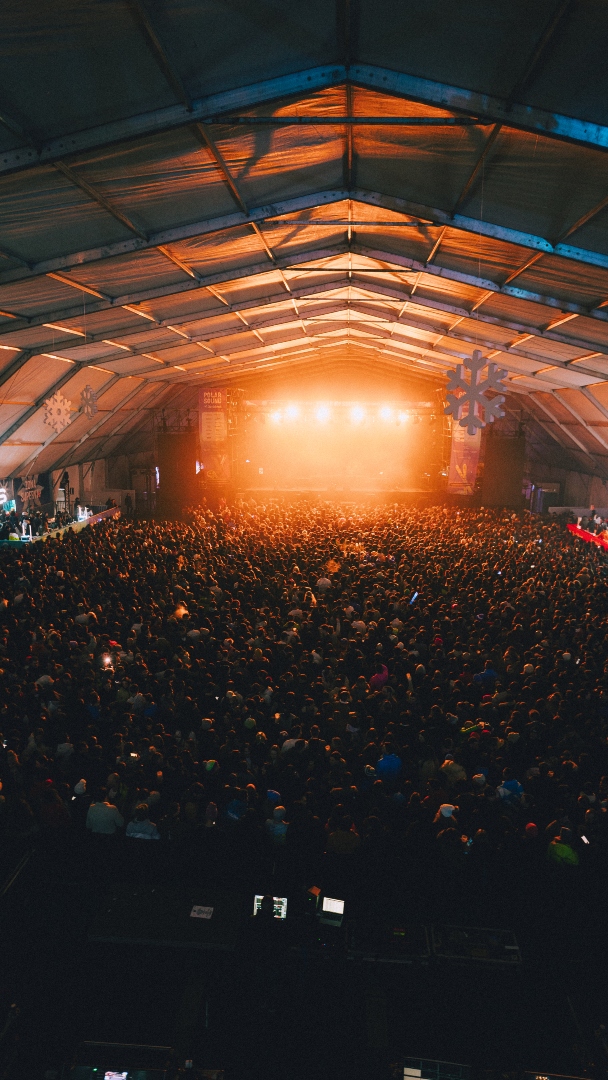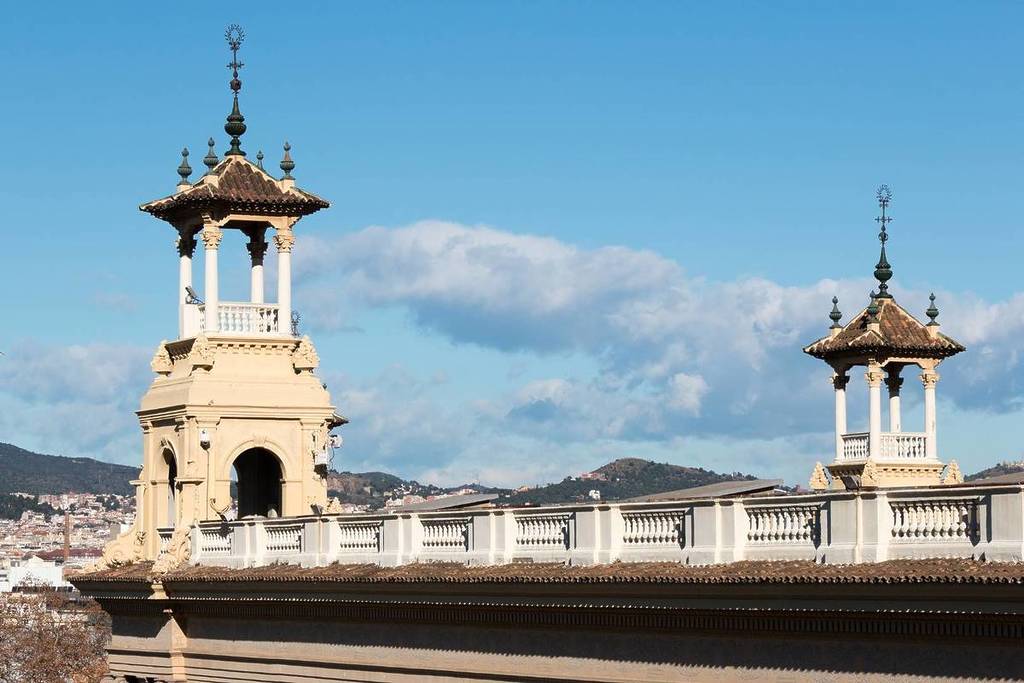

Two years before renovations begin to incorporate it into the MNAC, the Palau Victòria Eugènia has become the temporary home of IDEAL Barcelona. But the history of this building (and its twin, the Palau Alfons XIII), located between the Palau Nacional and the Magic Fountain at the Fira de Barcelona, dates back more than a century.
1. A new life for Montjuïc: the reason behind its construction
In the early 20th century, Montjuïc was practically isolated from the rest of Barcelona. It was the architect Josep Puig i Cadafalch who began to promote its development, proposing this area as the site for the 1929 International Exposition.
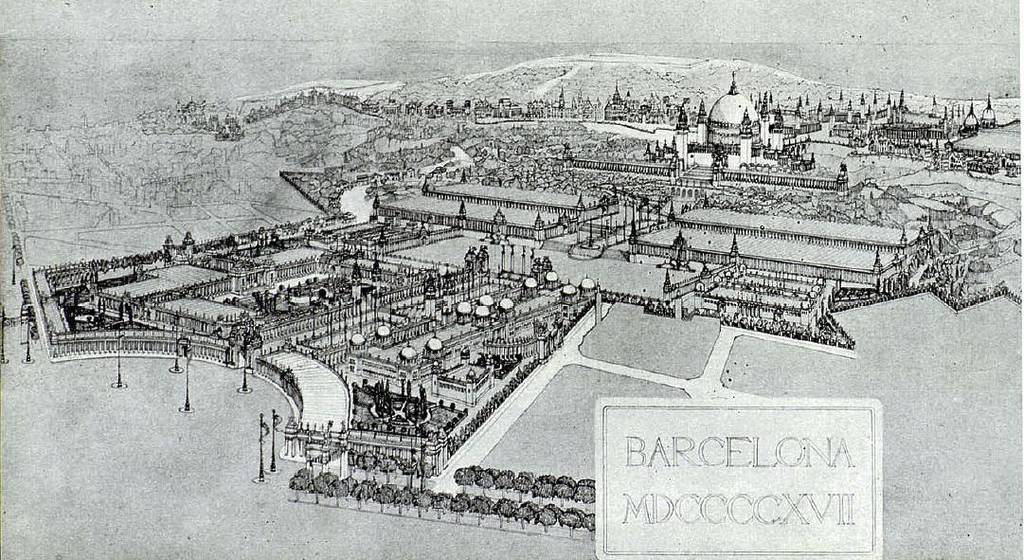
The ambitious project began in 1917, and construction of the twin palaces continued until 1923. The Palau Victòria Eugènia was officially inaugurated on May 19, 1929, coinciding with the opening of the Exposition. In 1930, the building became part of Fira de Barcelona, and following a major renovation in 2018, it was announced that the pavilion would be integrated into the MNAC in preparation for the centennial of the Exposition in 2029.
2. It is named after a queen
Victoria Eugenia of Battenberg, Queen Consort of Spain from 1906 to 1931 and granddaughter of Queen Victoria of England, is the namesake of the palace. The organizers of the Exposition named the building in her honor to associate the project with the elegance and progress that Victoria Eugenia represented: the queen introduced customs such as smoking and wearing pants to the court, practices that were very uncommon among women of high society (and even less so among royalty). The twin palace, directly across from it, bears the name of her husband, King Alfonso XIII.
3. It covers 14,000 m² and features towers inspired by Valencia crowning its corners
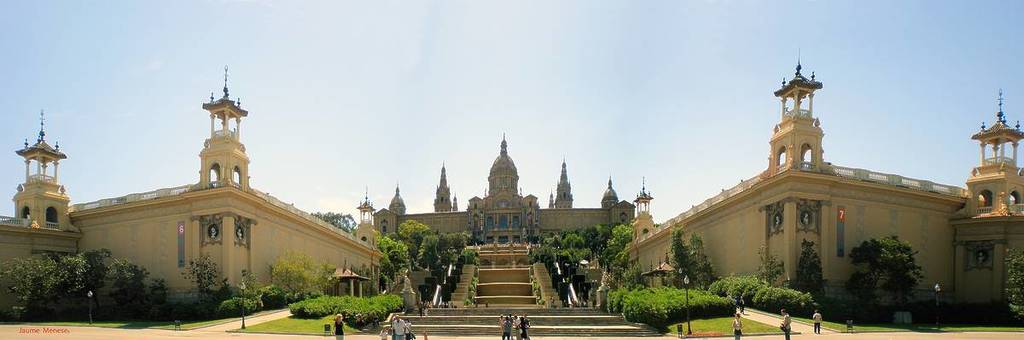
The Palau Victòria Eugènia is an example of Puig i Cadafalch’s “white monumentalist” phase, in which the architect moved beyond the Modernism of Casa Amatller and Casa de les Punxes to embrace a blend of Classicism, Catalan Baroque, and Novecentism.
We are talking about a 14,000-square-meter building, designed to accommodate large crowds and house massive infrastructure, with staircases inside to bridge the mountain’s elevation changes. On the exterior, its towers—inspired by the Royal Bridge of Valencia—and the sgraffito on the walls, which mimic Solomonic columns and garlands, stand out. The 2018 renovation reopened the pavilion’s interior space, allowing sunlight to once again enter through its skylights.
4. Four columns paying homage to Catalonia preside over the exterior of the pavilion
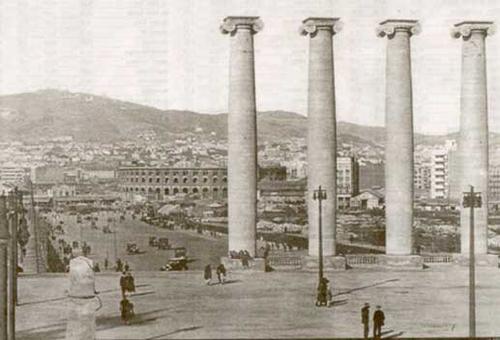
The area surrounding the Victòria Eugènia was also the scene of political tensions. In 1919, Puig i Cadafalch built the famous Four Columns in front of its façade, symbolizing the four red stripes of the Catalan flag. In 1928, during Primo de Rivera’s dictatorship and just one year before the Exposition, the columns were demolished in an attempt to erase any trace of Catalan identity. In 2011, they were rebuilt and re-inaugurated.
5. Today, it is a center for digital arts…
Today, the pavilion is undergoing a period of transformation: while the IDEAL Barcelona facilities are in the midst of a renovation, the Victòria Eugènia has become its temporary home. The space hosts The Last Days of Pompeii, an immersive exhibition endorsed by National Geographic that allows visitors to travel back in time to Ancient Rome and experience the natural disaster that destroyed Pompeii. The exhibition combines historical artifacts and replicas with journeys through the metaverse and virtual reality rooms where visitors can experience everything from gladiator battles in the amphitheater to the eruption of Vesuvius itself.
6. …and in the future, part of the MNAC
The major transformation of the Palau Victòria Eugènia will take place in 2029, with its definitive integration into the Museu Nacional d’Art de Catalunya (MNAC). This expansion project will add 19,000 square meters of exhibition space, and both buildings will be connected by a new passageway. The primary goal of the renovation is to improve access so that the climb up to Montjuïc becomes a natural stroll fully integrated into the life of Barcelona.