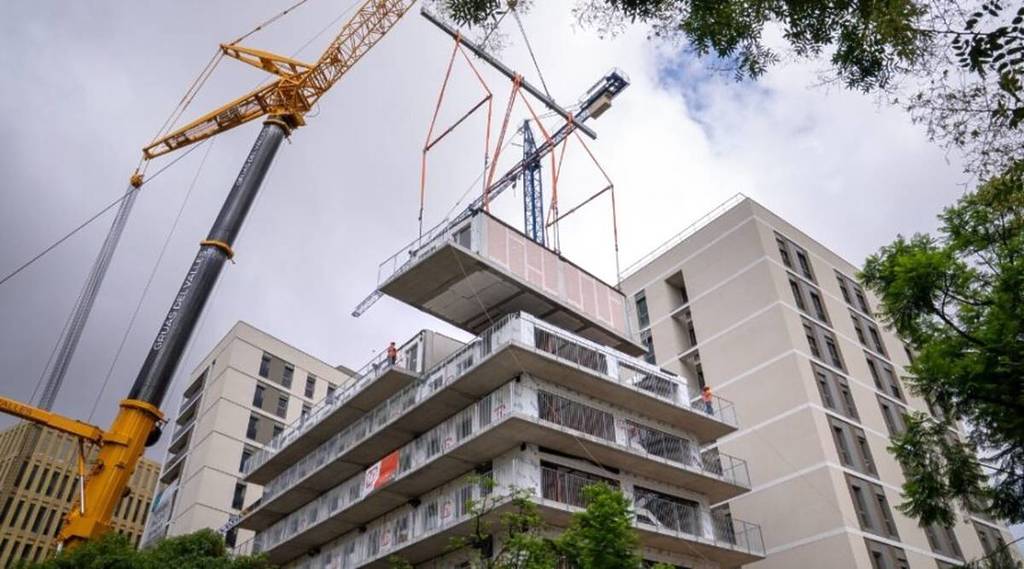
Fast, safe and sustainable public housing. In just 10 days, Barcelona has managed to assemble a block of 40 homes in the Bordeta neighborhood using an innovative industrialized modular construction system. The key: 48 fully equipped three-dimensional modules, manufactured in a workshop and assembled on the site as if they were Tetris pieces.
The building, located at Avinguda del Carrilet 22-24 (Sants-Montjuïc), will have 9 floors and will offer rental housing mainly for young people and single-parent families. But the most surprising thing is not only the speed, but everything behind this type of construction: less waste, less emissions, more job security and less dependence on the climate.
How is a building assembled in 10 days?
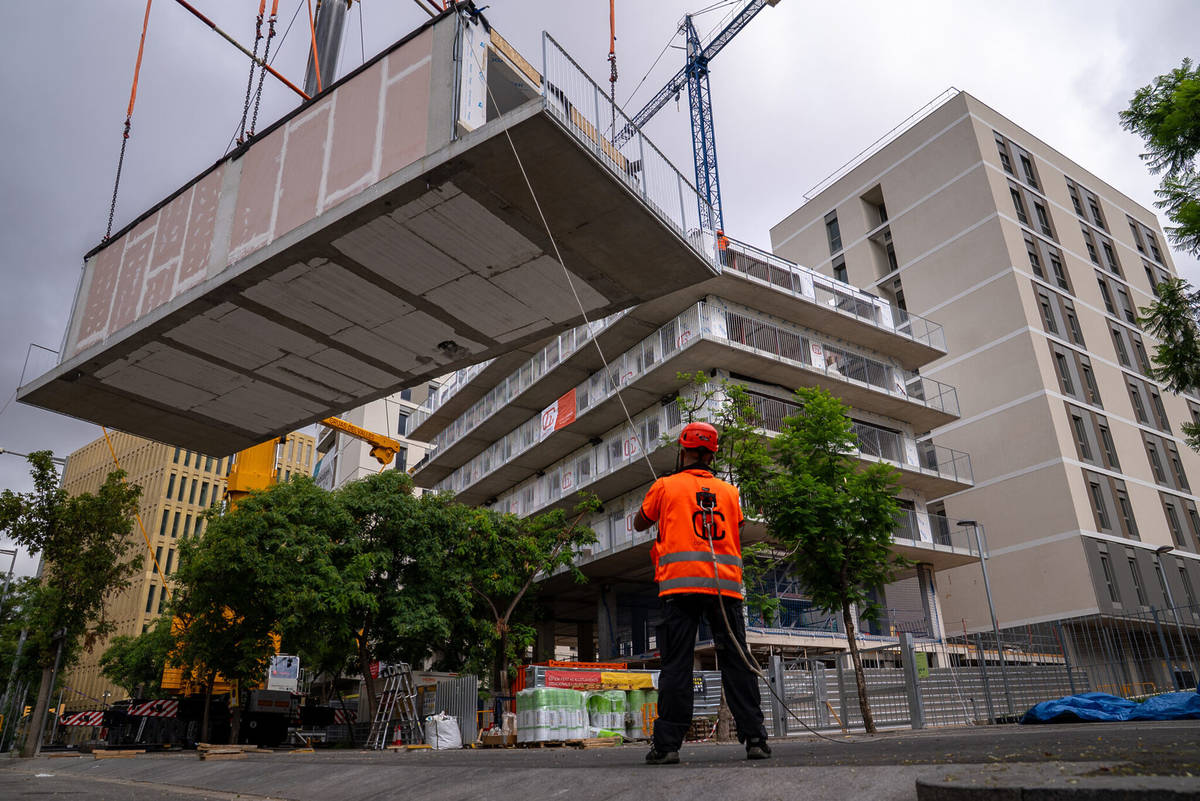
The modules that make up each house are manufactured on an assembly line with everything included: kitchen furniture, bathrooms, windows, electrical installations…. All this takes place while the foundations are being prepared on the site, which makes it possible to overlap processes and cut lead times by half compared to a conventional construction site. Once ready, the modules are transported and assembled like LEGO blocks at full speed.
Each apartment will have a 9 m² terrace (corner apartments will have 23 m²), and there will also be common areas such as a communal dining room, multi-purpose spaces, laundry, municipal rooms and bicycle parking. The keys are scheduled to be handed over at the end of 2026.
The future is already here (and it is being built like this)
Barcelona has become the city with the most industrialized public housing in Spain, with a total of 421 apartments in 9 developments. Some of these developments already delivered are in neighborhoods such as Sant Martí or Glòries, including the famous APROP temporary housing built with shipping containers.
This type of construction, common in northern Europe but still incipient in Spain, automates processes, reduces costs and time, and improves sustainability. And in a context of housing emergency like the current one, it is also a tool for accelerating solutions.
The work was designed by Vivas Arquitectos, Judith Crespo and Oihana García, and executed by Constructora del Cardoner and CompactHabit, a company specializing in this type of module. The total investment exceeds 6.7 million euros.
This is not the first building of this type to be constructed in Barcelona. For example, a few years ago, a building was constructed with shipping containers in Ciutat Vella for public housing, which shows that this type of construction is becoming increasingly common in the city.