There was a time, not so long ago, when sharing a flat was a romantic stage of youth. A rite of passage between second-hand IKEA furniture and dishwashing shifts that served to save money before taking the leap into “real” adult life. But times have changed and, according to the latest data, sharing a flat in the Barcelona areais no longer a vital choice, but a risky sport for your pocket.
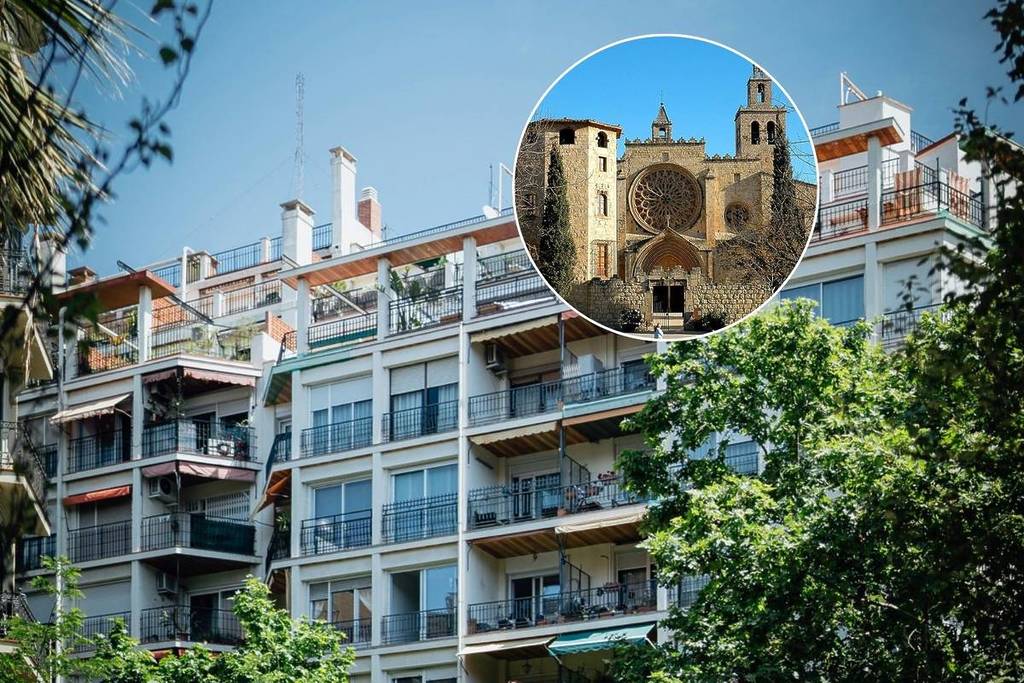
The most surprising thing is not that prices are still sky-high, but where the epicenter of this financial earthquake has been located. According to the latest report from the real estate platform Fotocasa, if you thought the glass ceiling was in Gràcia or Ciutat Vella, you were wrong. The most expensive municipality in Spain to rent a room is now 20 minutes from Barcelona.
The €722 overtaking
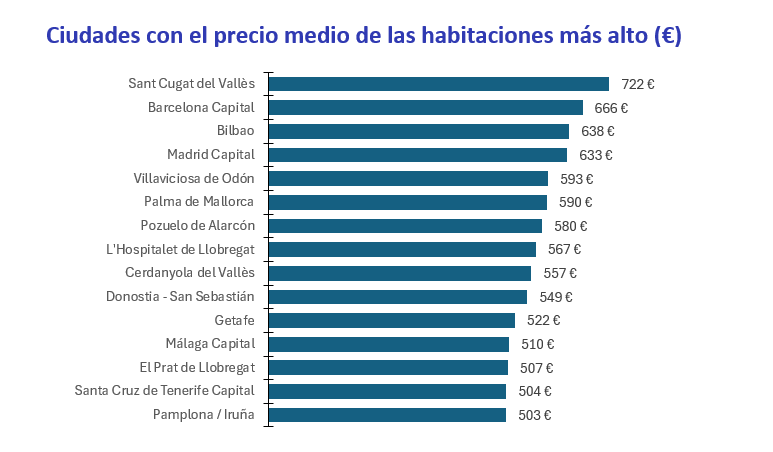
Living in Sant Cugat has always had an aura of exclusivity, but the current figures are simply out of this world. According to the latest report from Fotocasa, the average price of a room in this neighboring town has climbed to €722 per month. To give us an idea of the magnitude of the tragedy: renting a room in Sant Cugat is now more expensive than doing so in the center of Barcelona (€666), Madrid (€633), or Bilbao (€638).
This phenomenon is a kind of domino effect. Real estate pressure in the capital has pushed thousands of people into the metropolitan belt, but Sant Cugat, with its green spaces and premium connectivity to the Ferrocarrils railway, has become saturated to the point of reaching what experts call a “glass ceiling.” Salaries can no longer keep up, and the market seems to have reached a point of exhaustion where prices remain at historic highs simply because tenants can no longer stretch their budgets any further.
Other municipalities such as L’Hospitalet de Llobregat (€567) and Cerdanyola del Vallès (€557) are also following this upward trend. What was once an affordable alternative for students and young professionals has become an extension of the Barcelona market, where demand remains extremely high despite the fact that salaries are not growing at the same rate as rents.
An X-ray of resistance in Barcelona
If we return to the city of wonders, the outlook is not much more encouraging, although there are still small islands of sanity, if paying half your salary for ten square meters can be called sanity. Catalonia remains the most expensive autonomous community for those looking for shared accommodation, with a regional average of €638, which places us above Madrid and the Balearic Islands.
Living in Barcelona has never been cheap, but the current figures put the city in a league of its own. To give us an idea of the effort involved, renting a room today costs 62% more than five years ago and almost double what it cost a decade ago. In this scenario, Sarrià-Sant Gervasi is crowned the most exclusive district, being the only one to break the €700 barrier on average for a room.
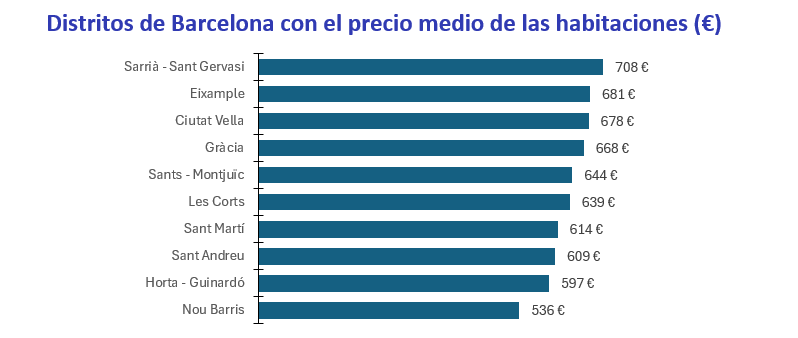
It is closely followed by the usual suspects: Eixample, with an average of €681, and Ciutat Vella, with €678. Even districts that were traditionally considered more “affordable,” such as Sant Andreu, have experienced the highest percentage increases in the city, now approaching €610. The only small respite is in Nou Barris, which remains the most affordable district with an average of €536, one of the few places where prices have fallen slightly compared to the previous year.
Within Barcelona, Sarrià-Sant Gervasi continues to lead the ranking, as it is the only district in the city to break the €700 barrier. However, it is not all bad news for those looking to move this month. The report reveals an interesting fact: Sant Martí and Nou Barris are the only districts where prices have taken a slight breather, registering decreases of between 2% and 4%. Currently, Nou Barris remains the last refuge in the capital with an average of €536 per month.
Beyond housing: the refuge of garages
The situation is so extreme that even the way people invest in the city is changing. According to additional data from Idealista, we are facing an unprecedented real estate paradox. The profitability of buying a home to rent in Barcelona is being surpassed by something much more mundane: parking spaces.
At a time when access to housing is blocked by prohibitive prices and new regulations, many small savers are diverting their money to parking spaces, which offer more stable returns and fewer headaches than managing a shared apartment. In the end, it seems that in Barcelona it is more profitable to find a home for your car than for yourself.
Meanwhile, we Barcelonians are left with the usual consolation: keep looking for that ad that isn’t a squat and pray that our next roommate, at least, knows that toilet paper doesn’t replenish itself.