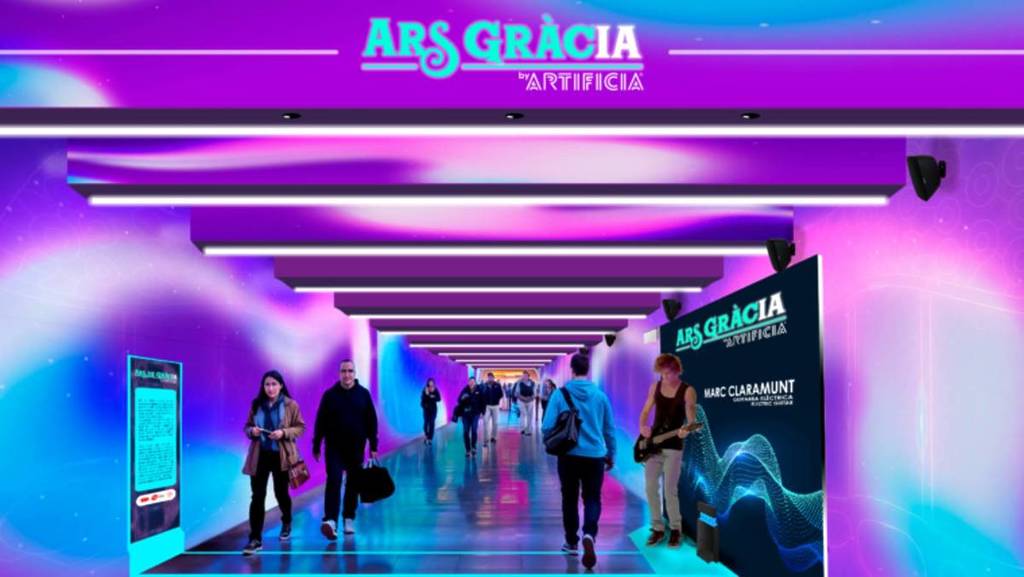
Starting in November, the transfer between metro lines 3 and 4 at Passeig de Gràcia will no longer be a simple subway route but will be transformed into an immersive art installation. For three months, users will become the protagonists of a symphony generated by artificial intelligence thanks to the ARS GRÀCIA project, a proposal that unites music, technology and city.
The initiative, promoted by the Catalan platform ARTIFICIA, was the winner of the challenge launched by Barcelona City Council, TMB and the BIT Habitat Foundation to improve the experience of the more than 70,000 travelers who cross this long corridor every day. The goal? To turn those eight minutes of walking into a sensory experience that combines generative music, visual projections and constantly evolving light beats.
A 237-meter-long musical instrument made with AI

The system, which will function as an interactive orchestra, will transform each person into a musical note. Depending on their movement or position, the AI – developed with the support of the Artificial Intelligence Research Institute (IIIA-CSIC) – will generate unique sound and visual patterns that will fill the space with digital life.
But not everything will be virtual. The ARS STAGE, a physical space inside the transfer, will host live performances by musicians from the Association of Street and Metro Musicians of Barcelona (AMUC), who will be able to play in optimal acoustic conditions and with the reinforcement of the system’s visual effects.
The pilot test will only be applied in a specific section of the corridor, after a previous phase in a controlled environment to ensure universal accessibility. The project will receive 50,000 euros in funding – 80 % of the budget – plus an additional prize of 3,000 euros.
In addition to ARS GRÀCIA, the jury awarded 3,000 euros to two other finalists: Atmósferas en Tránsito, by the We Are Labels collective, and El Cànon de Barcelona, by the Flop Work team.