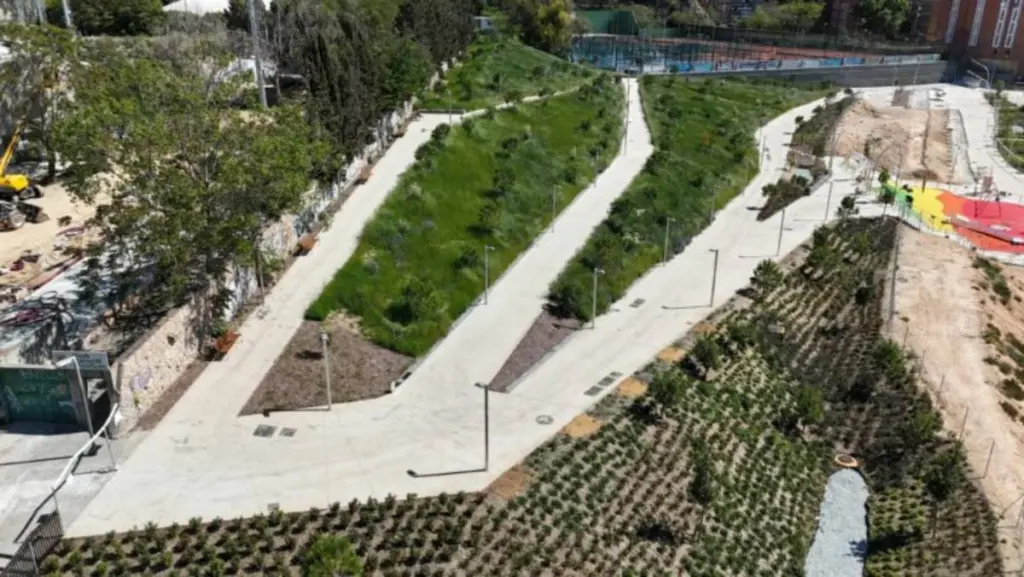

For decades, the upper part of Can Clos and La Vinya lived with the scars left by the old quarries and brick factories on the slopes of Montjuïc. Today, that landscape of disturbed earth has been completely transformed: after nearly three years of work spearheaded by the Municipal Institute of Urban Planning since the spring of 2022, the neighborhood is unveiling a large park that restores the mountain’s original topography and opens up new walking paths to the green space.
The transformation is divided into two large areas located in the Sants-Montjuïc district, straddling Carrer dels Ferrocarrils Catalans, Carrer de les Diligències, Camí de Can Clos, and Carrer de la Foneria and Carrer de l’Onyar. The result combines a Mediterranean forest, play areas designed for all ages, and new access points that connect the neighborhood to the mountains—all while residents are currently deciding on the site’s official name.
Recommended Articles
 Passeig de Gràcia, closed today and tomorrow in Barcelona for the Christmas lights ceremony: which sections are closed until Thursday, the 26th
 2026 Christmas Lights in Barcelona: The Lighting Date and Location Have Been Announced
A 9,400-square-meter forest and a connection to Montjuïc
The main component of the project covers 20,100 square meters and is divided into two distinct areas. On one side is a 9,400-square-meter urban forest that follows the mountain’s natural slope and connects to the promenade via paths ascending from the old Camí de Can Clos to the Club Natació Montjuïc. On the other, a more urban strip covering 10,700 square meters that connects directly to the Can Mestres urban gardens, adding a new green space to the city’s network of green areas.
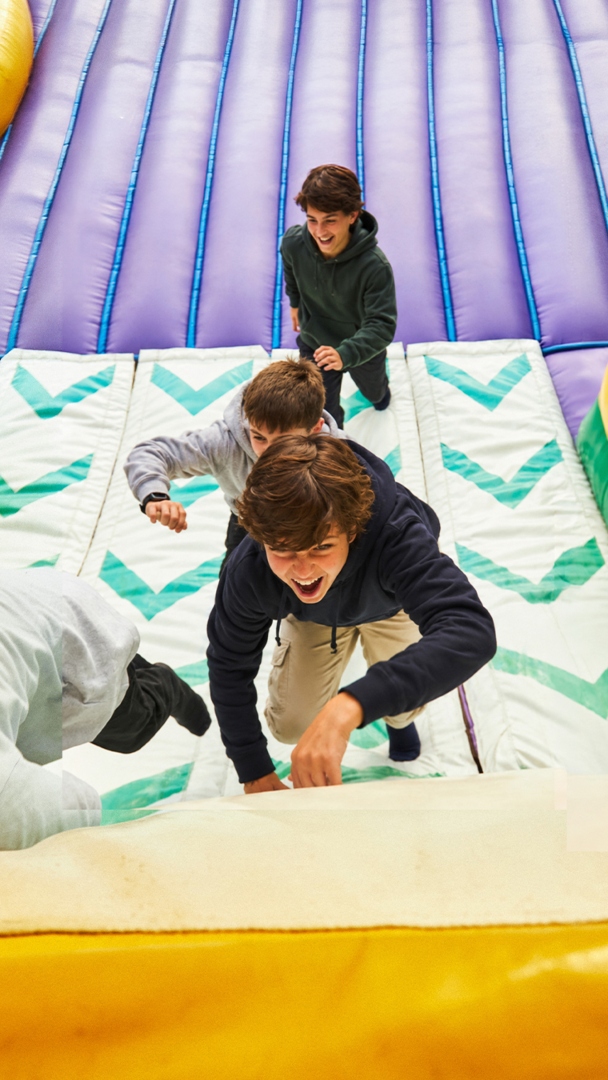
In this more accessible section, a paved and accessible walkway has been created, featuring a large central flowerbed that not only adds greenery to the path but also collects rainwater from the surface and nearby buildings to return it to the ground. With neighborhood families in mind, the park also features a new, inclusive children’s play area covering about 450 square meters, complete with swings, a slide, ropes, spinning rides, and a climbing wall that takes advantage of the slope of the terrain with adapted ramps.
A few steps away, a second, smaller area of 4,600 square meters—of which 2,340 are landscaped—completes the renovation with new paths accessible from Carrer dels Ferrocarrils Catalans and a new plaza facing Carrer de Riudaura.
Pine trees, almond trees, and four apartment buildings surrounding the area
To bring the entire complex to life, 236 trees have been planted—mostly pines, almond trees, and olive trees—accompanied by shrubs and meadows of native species that require very little watering. Even the walls have been covered with climbing plants to integrate greenery into every corner. The outdoor furnishings include benches and chairs with backrests, a fountain, three bicycle parking areas, and energy-efficient lighting, in addition to the renovation of basic utilities such as water, electricity, gas, and fiber-optic internet.
The area surrounding the park will not remain empty either: four buildings ranging from five to seven stories will be constructed around this new green space. Two of them are private residential buildings—each with 62 apartments—and construction is already underway, while the other two will be public housing projects, with 64 and 17 apartments respectively, and construction will begin soon. This change in the area’s appearance joins other recent transformations on this less-traveled side of the mountain.
Three names on the table for the park’s name
Although the park is now a reality, it still lacks an official name. To address this, the Eix de Cultura i Memòria Històrica de la Marina and the Sants-Montjuïc district have launched a neighborhood vote based on proposals developed by the neighborhood’s memory committee.
The three finalist options are Jardins del Tren de la Potassa, Jardins de les Vinyes de Can Clos, and Jardins del 8 d’Abril. Anyone wishing to participate can cast their vote in person at the Casal de Barri de la Vinya through February 18. Once the ballot box is closed, the chosen option will be reviewed by the Barcelona City Council’s Nomenclature Committee and will receive final approval at the Sants-Montjuïc district council meeting.