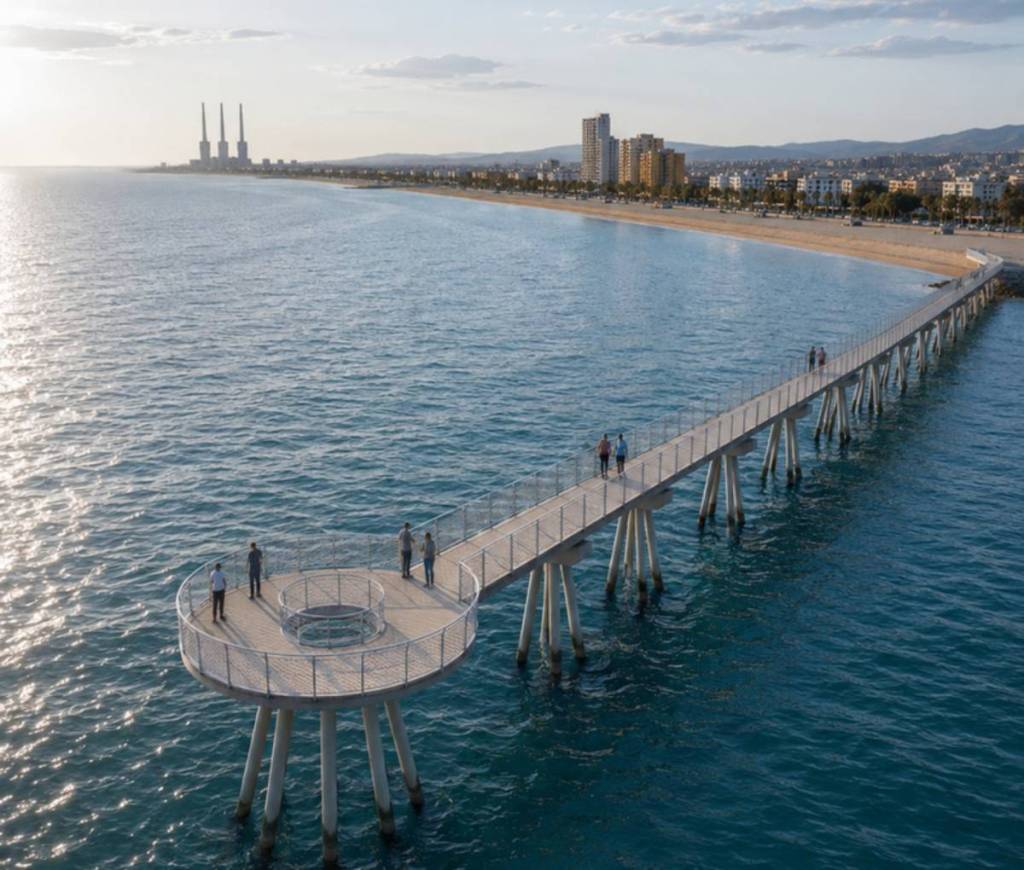

The reconstruction of the Pont del Petroli in Badalona begins this June with the aim of restoring an infrastructure that was rendered unusable following the damage caused by Storm Gloria in January 2020. The project has a budget of 4,082,786.64 euros, jointly funded by the City of Badalona and the Barcelona Metropolitan Area (AMB), and is expected to be completed by the end of 2026.
The architectural project covers the entire bridge, which is 234.5 meters long and 3.20 meters wide, in additionto a terminal platform of approximately 130 square meters. The project is being managed following the signing of a collaboration agreement between the two administrations in October 2024, as part of the Territorial Cohesion Action Program (PACTE) of the 2020–2023 Metropolitan Investment Plan.
A design adapted to climate challenges
The new structure has been designed according to sustainability and resilience criteria to withstand more intense storms. The technical proposal has been validated by the Maritime Engineering Laboratory of the Polytechnic University of Catalonia (UPC) through scale simulations and three-dimensional numerical models.
Ramon Torra, director of the AMB, notes that the project exemplifies contemporary public space design in the face of climate change, emphasizing that the future bridge is designed to withstand severe adverse weather events. He also explains that the project “symbolizes the restoration of a historical heritage that we wish to preserve and strengthen,” linking it to the industrial past and the identity of the northern metropolitan coastline.
For his part, the mayor of Badalona, Xavier Garcia Albiol, highlights the sentimental value of the space, stating that “the Pont del Petroli is more than just infrastructure; it is a fundamental part of the city’s emotional identity.” The mayor notes that the work involves “restoring a part of Badalona’s soul after six years of closure” and warns that the construction will cause inconvenience to residents, though he is confident they will understand the disruptions.
Phases and methodology of the maritime project
Initial work will be concentrated during the month of May at the Port of Badalona, where the prefabricated materials will be received. Starting in early June, the work will move to the bridge itself and will be carried out from the sea using a pontoon, a specialized vessel that will be anchored to the seabed to minimize the impact of the waves.
The construction process will be divided into the following phases:
- Demolition and removal: The sections structurally damaged by storms will be demolished, the old, disused platform will be removed, and the old piers will be extracted.
- Reconstruction: The damaged sections will be removed and the new end platform will be installed. The sections of straight beams will be replaced with new elements that comply with current regulations, while the undamaged beams will be repaired to address cracks and spalling.
- Protection and finishes: A surface coating of paint will be applied to the entire structure to extend its service life and unify the finish. Finally, the lighting, railing, and wooden decking will be renovated.
Greater hydrodynamic resistance
The new end platform has been designed in the shape of a circular ring and will have a surface area of 132 square meters, with a central opening of 19 square meters. Its metal structure will rest on 11 pylons 80 centimeters in diameter, which will be anchored about 12 meters deep beneath the seabed sand. To minimize the horizontal impact of waves over 6 meters high—such as those recorded in 2020—the platform’s surfaces will be sloped to provide more hydrodynamic performance.
This infrastructure was originally built in 1965 by the Campsa company for the unloading of petroleum products. After losing its industrial function, it was converted in 2009 into a public space as an extension of the town’s seaside promenade.