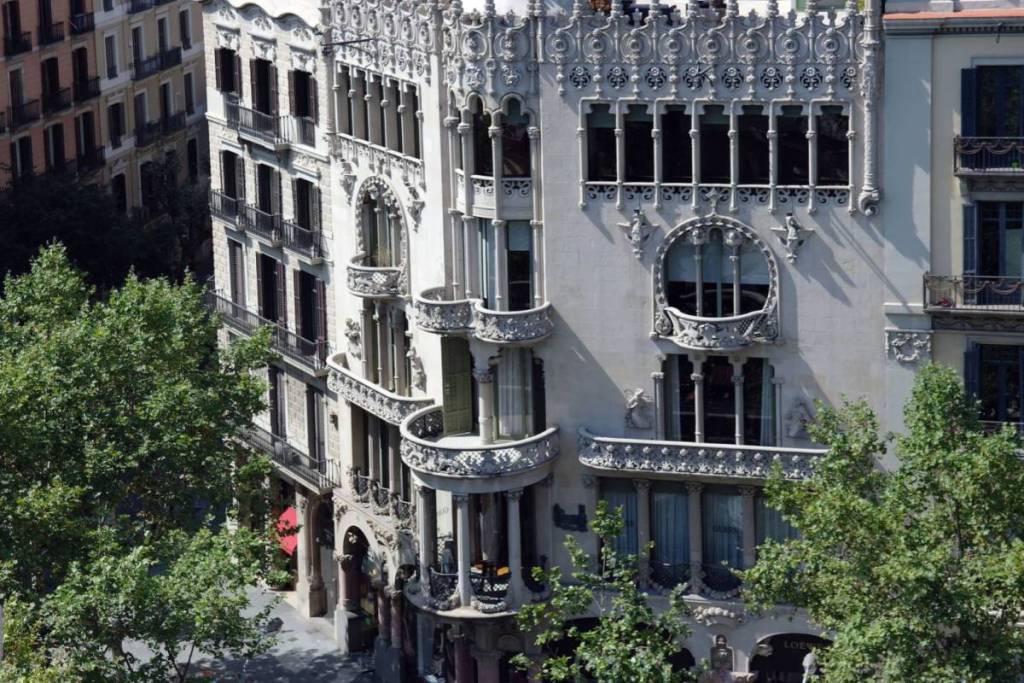

Casa Lleó Morera, one of the most outstanding examples of Catalan Modernism, will reopen its doors to the public after a decade of being closed to visitors.
The Barcelona City Council has approved a comprehensive special plan during a Housing Committee meeting, following a proposal by the real estate firm Núñez i Navarro, which owns the building, paving the way for its reopening.
The building is located on the southern corner of the so-called “Block of Discord,” at the intersection of Passeig de Gràcia and Carrer Consell de Cent, in the Eixample district. It shares the block with the Casa Amatller, designed by Josep Puig i Cadafalch, and the Casa Batlló, designed by Antoni Gaudí, on one of the city’s most visited stretches.
Although there is no official opening date yet, it is expected to open sometime this year or early next year.
A collective work of Modernism
The building was constructed in 1905 by architect Lluís Domènech i Montaner —also the designer of the Palau de la Música Catalana—commissioned by the Morera family, who wanted to renovate the former Casa Rocamora, dating from 1864.
The result was a project that brought together some of the most renowned artisans of the time: the sculptors Eusebi Arnau and Alfons Juyol, the glassmakers Rigalt and Granell, and the mosaic artists Mario Maragliano and Lluís Bru.
This concentration of specialized crafts makes the interior of Casa Lleó Morera one of the best-preserved ornamental ensembles of Barcelona’s Modernism.
The profusion of naturalistic motifs in various materials—stone, glass, mosaic—is characteristic of the style and reflects the taste of the family that owned the building for three generations, which helped preserve much of its original features.
Ten years off the tourist circuit
After changing hands several times following its departure from the Morera family, the building was acquired in 2003 by Núñez i Navarro, which developed a restoration and conservation plan. However, public access was suspended approximately a decade ago.
The approval of the comprehensive special plan provides the necessary administrative framework to resume tours. The project does not yet have a confirmed opening date, but the city’s decision clears the main obstacle to this building’s return to Barcelona’s Modernist architectural circuit.