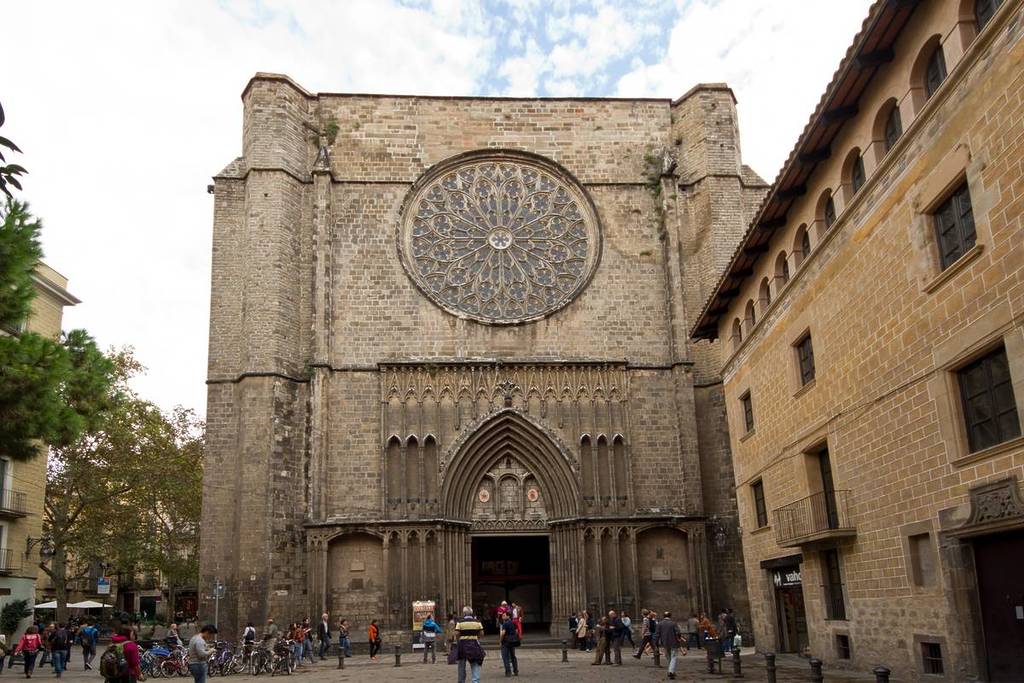
It couldn’t be in a more privileged location, just a few steps from La Rambla and in the heart of the Gothic Quarter. Even so, being almost next to the Cathedral, it often goes unnoticed. We are talking about Santa Maria del Pi, a basilica whose origins date back more than 1,000 years, an architectural gem that has survived all kinds of historical events and catastrophes and continues to stand majestically as a place of worship and also as a venue for very unique performances.
Once upon a time, there was a Virgin on a pine tree
Legend has it that near the current basilica, a pine tree was found with the image of the Virgin Mary on its trunk. This event gave rise to the cult of the Church of the Pine Tree, which already had its own temple at the end of the 10th century (Romanesque in style at the time) and is recorded in documents as an ecclesiastical parish in 1188. But what became of that church? Given that no remains of it have ever been found, everything points to the fact that, after it was demolished, its remains were buried under the current basilica, whose construction began in the early 14th century.
What we know today as Santa Maria del Pi is something of a remake of something that already existed, expanded and improved. Although this construction process was slow and complex… Isn’t that always the case with Barcelona’s great architectural works?
 Editorial credit: Maria Rosa Ferre (Wikimedia Commons)
According to documents from the period, we know that in 1351 there was already a chapel with altars dedicated to Sant Climent and Sant Llorenç, and that in 1332 work was already underway on the fourth section of the nave, which was covered during the second half of the 14th century.
The final push came from Pere el Cerimoniòs, monarch of the Crown of Aragon and Mallorca. Known for his energetic and harsh reign (which always involved showing off on a religious level), in 1379 he made the donation that allowed the bell tower to be built. Although it was inaugurated as a basilica in 1453, another important phase of construction took place between 1460 and 1497, the year of his death, under the direction of master builder Bartomeu Mas. This marked the end of the basilica as we know it… Although, as we will explain later, the scaffolding had to be erected again on several occasions.
A jewel of Catalan Gothic architecture
 Editorial credit: Josep Renalias (Wikimedia Commons)
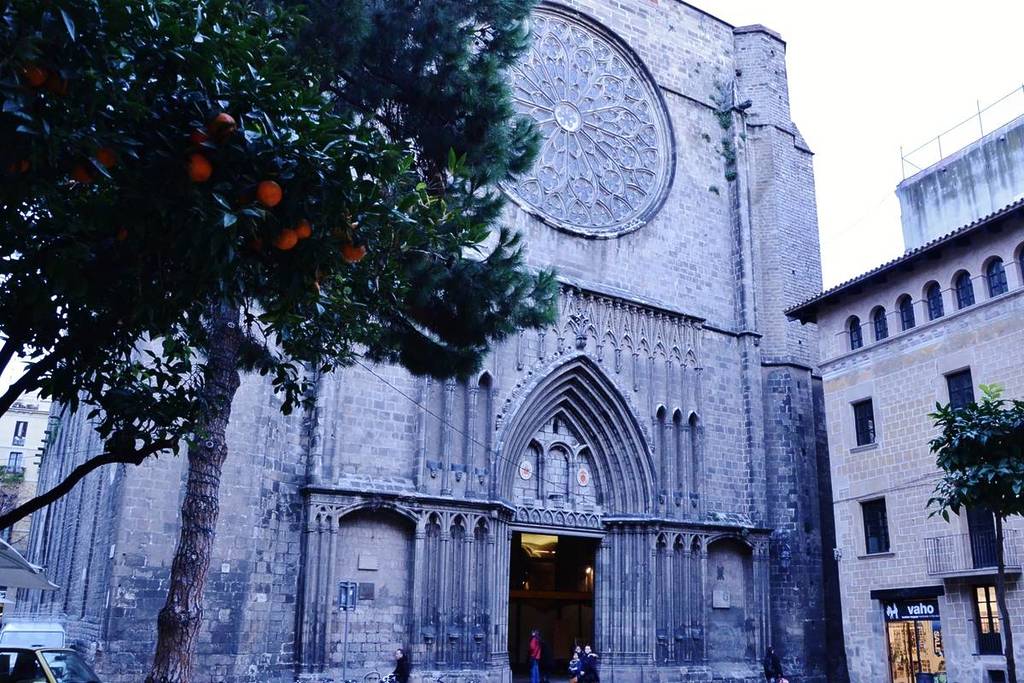
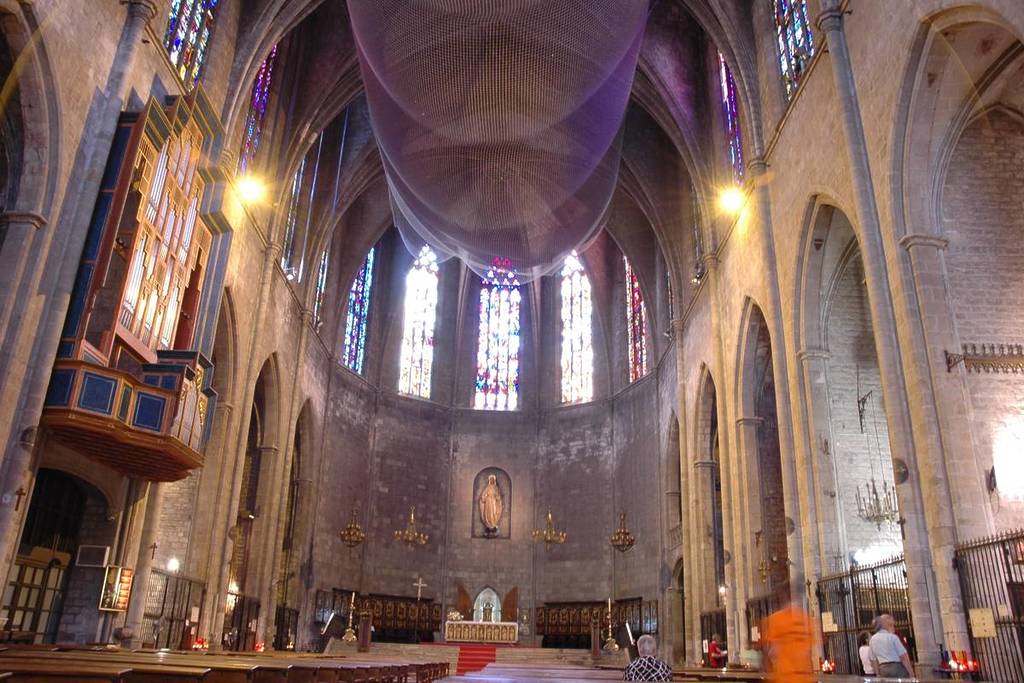
If we are looking for an example of the purest Catalan Gothic style, Santa Maria del Pi is perfect for understanding it. To begin with, it has a single nave, high ceilings, and side chapels with buttresses. This sets it apart from its “neighbor,” Barcelona Cathedral, which has three naves, and from French Gothic cathedrals, which are characterized by flying buttresses (external arches). Seen from the outside, this church is austere (it has sculptures but little ornamentation) and looks more like a fortress than a place of worship.
Inside, its single-nave shape and horizontality create a spectacular visual effect, as nothing interrupts the view from the entrance to the altar. Its 17.5 meters in width make it one of the widest naves in Spain.
 Editorial credit: Jcca76 (Wikimedia Commons)
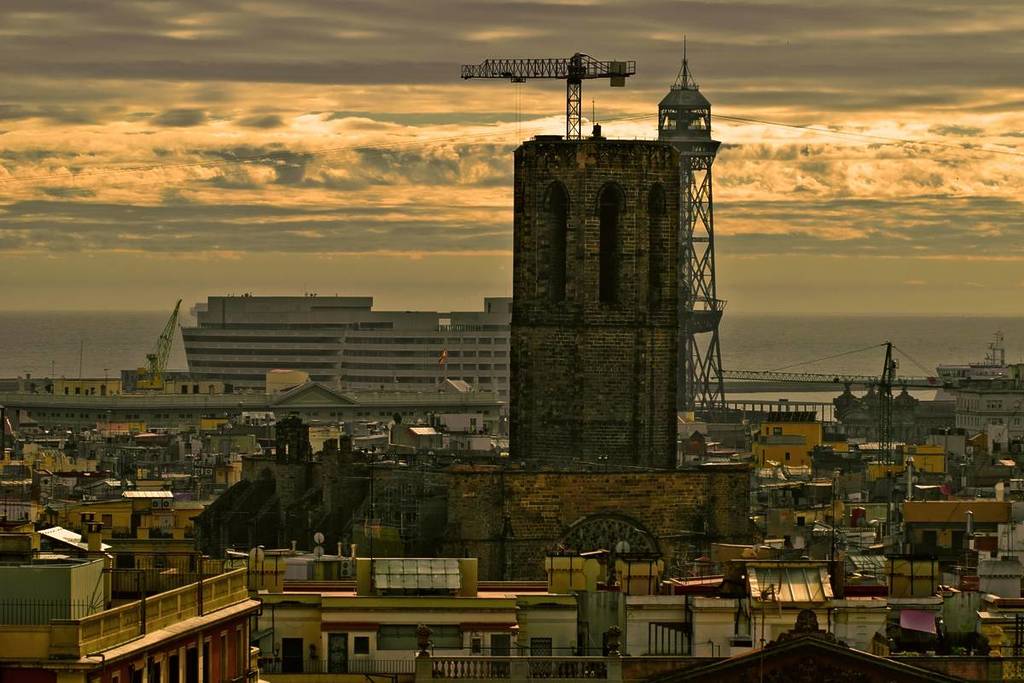
Also noteworthy is its enormous octagonal bell tower, 54 meters high and with walls 3.55 meters thick. In times of war , it served as a watchtower, and it is said that the sound of its bells was so loud that they could be heard from anywhere in Barcelona.
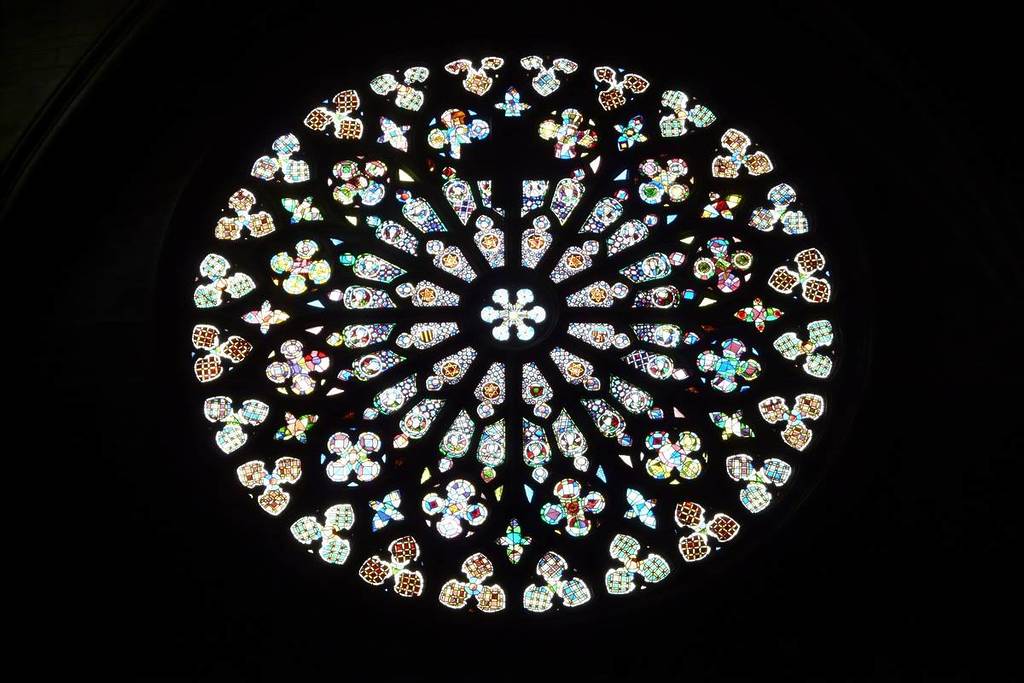
However, if there is one thing that particularly catches the eye, it is its iconic rose window. With a diameter of 10 meters, it is one of the largest in Catalonia, and its perfect geometry never ceases to amaze us. Furthermore, the fact that the façade of Santa Maria del Pi is so austere further highlights the beauty of this great “eye.”
The resilient basilica
 Editorial credit: Pere López (Wikimedia Commons)
The road to Santa Maria del Pi reaching the present day in all its splendor has been long and tortuous; during its long life, it has suffered various tragedies that have affected its structure. The first documented tragedy was in 1428 due to the famous earthquake in Catalonia. Although its epicenter was in Rosselló, Barcelona also suffered the ravages, and for Santa Maria del Pi it could not have been more tragic: it caused severe damage and the collapse of its rose window, causing several deaths.
The bombings of the War of Succession in 1714 also affected the basilica. This forced its reconstruction beginning in 1717, although it was not until 1863 that a real restoration project was carried out, improving the chapels, the doorway, and the exterior façade and eliminating the Baroque decoration of the temple. Some 50 years later, it was restored again, but the joy was short-lived.
In 1936, it was burned down during the Civil War, and in the 1950s, it underwent what is, for now, its last major renovation. Thanks to the work of Josep Maria Jujol (a famous modernist architect and collaborator of Gaudí), the beautiful rose window of Santa Maria del Pi was restored, leaving the basilica in its current impeccable condition.
An exceptional setting
Like all important religious temples, Santa Maria del Pi has daily services, but these are not the only events held on the premises. Its architecture makes the basilica a building with excellent acoustics, perfect for all kinds of musical performances.
The basilica is a regular venue for concerts, such as the participatory Christmas concert, some Candlelight shows, and currently hosts the LUMINISCENCE show. This event combines video mapping projections with classical music (digital and with a live choir in some sessions) and a narration that tells its story. Without a doubt, it is a beautiful tribute to what is, as you can see, a real gem of our city.
Bonus track: Did you know…? Little secrets of Santa Maria del Pi
 Editorial credit: basilicadelpi.cat
Now that you know the history of Santa Maria del Pi, don’t leave without learning that…
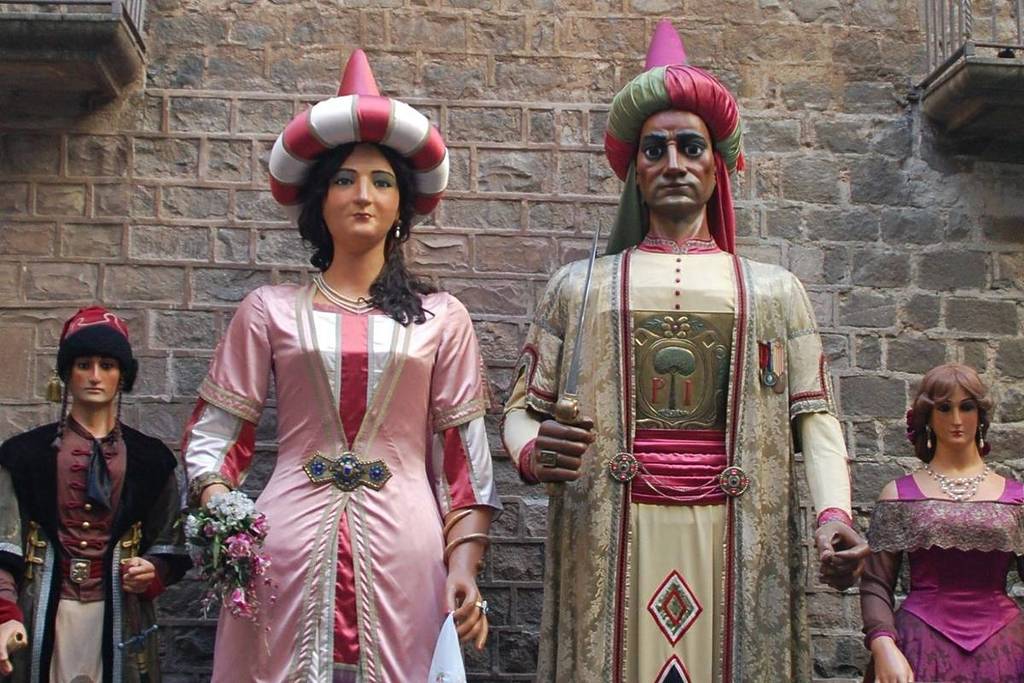
- It is the “home” of Barcelona’s giants, Mustafà and Elisenda. It is no coincidence that the popular song “El gegant del Pi” refers to Mustafà and this place. And when the giants are not parading through the streets, they rest at the entrance to Plaça San Josep Oriol.
- On one side of the church there is graffiti that reads “Plaça del milicià desconegut”(Square of the Unknown Soldier). Although its origin is uncertain, it dates back to the Civil War and survived 40 years of dictatorship, bearing witness to those who fought for freedom. Since 2004, the City Council has also placed a bronze commemorative plaque in honor of all those who fought against the Nationalist side.
- The basilica houses a large collection of jewels that have miraculously survived wars and looting. Among its pieces, the Processional Custody stands out, a work of gilded silver that was taken out in the Corpus Christi processions; the gold and silver altar crosses from the 14th and 15th centuries, in perfect condition; and the Cordobanes, altar frontals made of embossed, polychrome, and gilded leather (leather was considered a luxury material in the Middle Ages).
- It also has an invaluable parish archive of documents dating back to the 12th century, a collection that helps us understand the life of the people of Barcelona over the centuries. We have access to it thanks to the residents and archivists who, during the fire of 1936, risked their lives to save all these documents from the flames.