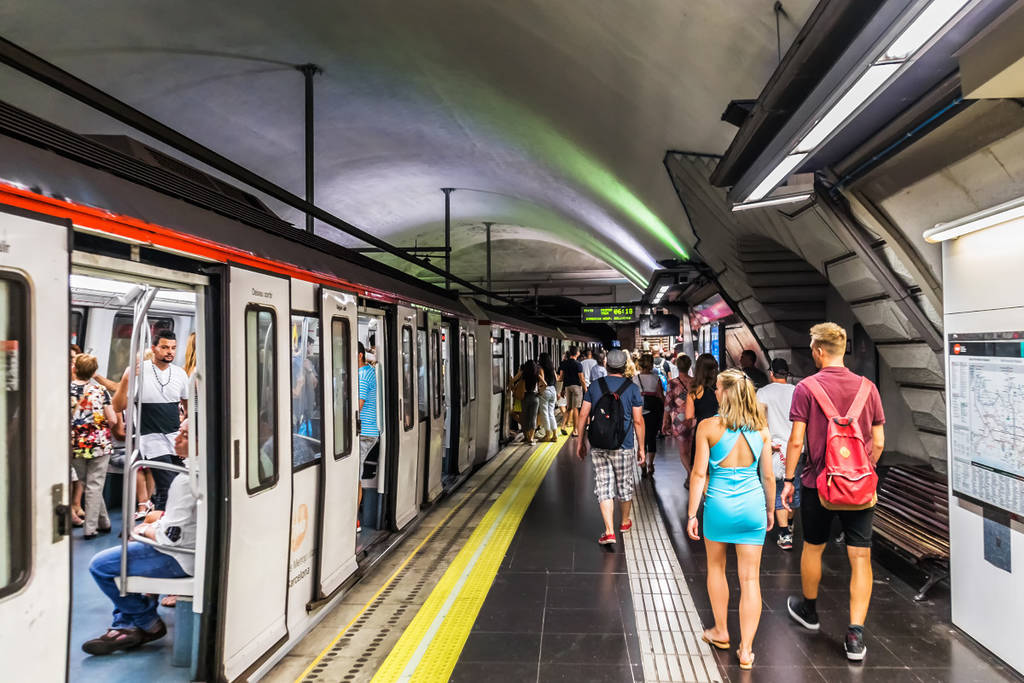

With the arrival of the heat and the usual drop in ridership due to the holidays, Barcelona’s underground is preparing to open up and get up to speed. Transportation authorities will use these months to carry out major technical renovation and accessibility work on the metro network,with the main service disruptions concentrated on lines L1 and L9, along with impacts at key hubs in the city center.
Unlike in previous years, the planning coordinated by the Catalan government and Transports Metropolitans de Barcelona (TMB) will begin later than usual, well into July. The reason for this delay is the overlap with major events such as the Pope’s visit and the Tour de France’s passage through the Catalan capital. The work, focused on renovating old tracks, removing asbestos, and improving network connections, will force thousands of residents to change their travel routines and use alternative bus and metro routes until early September.
Comprehensive track renovation on Line L1
The service disruption with the greatest impact on the public will occur on Line L1, where the track between the Santa Eulàlia and Mercat Nou stations will be completely renovated. In practice, service will be suspended from July 17 through August 28 on the section between the La Florida and Plaça de Sants stops.
This project, with an investment of 11.5 million euros, will affect some 43,000 daily riders in July and 36,000 in August on weekdays. It will also be used to replace the track switches providing access to the Santa Eulàlia maintenance facility
As a top alternative, officials suggest using the metro network itself:
- Connection with the L9 and L10 South at Torrassa station.
- Connection to L5 at Plaça de Sants.
- Connections with Ferrocarrils de la Generalitat at Avinguda Carrilet and Rodalies at Rambla Just Oliveras.
In addition, an alternative bus service will be provided to cover the affected section. Buses will run every 4 to 9 minutes on weekdays, every 5 to 10 minutes on Saturdays, and every 6 to 11 minutes on Sundays. Since the Plaça de Sants station is not yet accessible, a special shuttle bus will be available exclusively for people with reduced mobility.
A large construction pit on the L9/L10 Nord
The second major disruption of the summer will be concentrated in the northern part of the city. Between June 25 and September 6, trains on the L9 Nord and L10 Nord lines will cease running between La Sagrera and Onze de Setembre. This disruption will extend to Bon Pastor station during the final six days of the work. The reason is the construction of a massive shaft with a budget of 22.6 million euros, carried out by the Catalan government and designed to connect the northern branches with the future central section of the line, as they currently run through the L4 tunnel.
This work will affect an average of 3,300 daily validations on weekdays in July and 2,400 in August. TMB will operate replacement buses with wait times of 6 to 11 minutes on weekdays and 10 minutes on Saturdays and holidays. However, the metro remains the most efficient option: it is recommended to transfer to line L1 at Fondo or line L2 at Gorg, or to use the regular surface buses H8, 34, and 126, which follow the same route.
No stop at Verdaguer and street transfer at Catalunya
Two other projects, though smaller in scope in terms of kilometers, will affect the daily lives of users at key locations in Barcelona:
- Verdaguer Station (L4): Trains will bypass this stop between July 6 and August 30. The closure is necessary to proceed with work to adapt the transfer corridor (closed since last October) and the shafts where the new elevators and escalators connecting to Line L5 will be installed. The approximately 6,500 daily riders in July and 4,800 in August will have to get off at the adjacent stops at Joanic or Girona.
- Plaça Catalunya Interchange: The underground passage connecting L1 and L3 will be completely closed from July 6 to September 7. The work will involve removing the encapsulated asbestos under the ceiling and renovating the flooring, lighting, and ceiling at a cost of 1.2 million euros.
While the work is underway, the heavy flow of passengers will have to make the connection by walking outdoors. This street route has not yet been defined in detail, but it will be clearly marked.
These renovations coincide with the recent announcement of the extension of Line 3 (Green) through Trinitat, to connect Trinitat Nova and Trinitat Vella, finally making a long-standing demand a reality. Although the works have only just been approved, they will soon also affect the daily lives of residents.