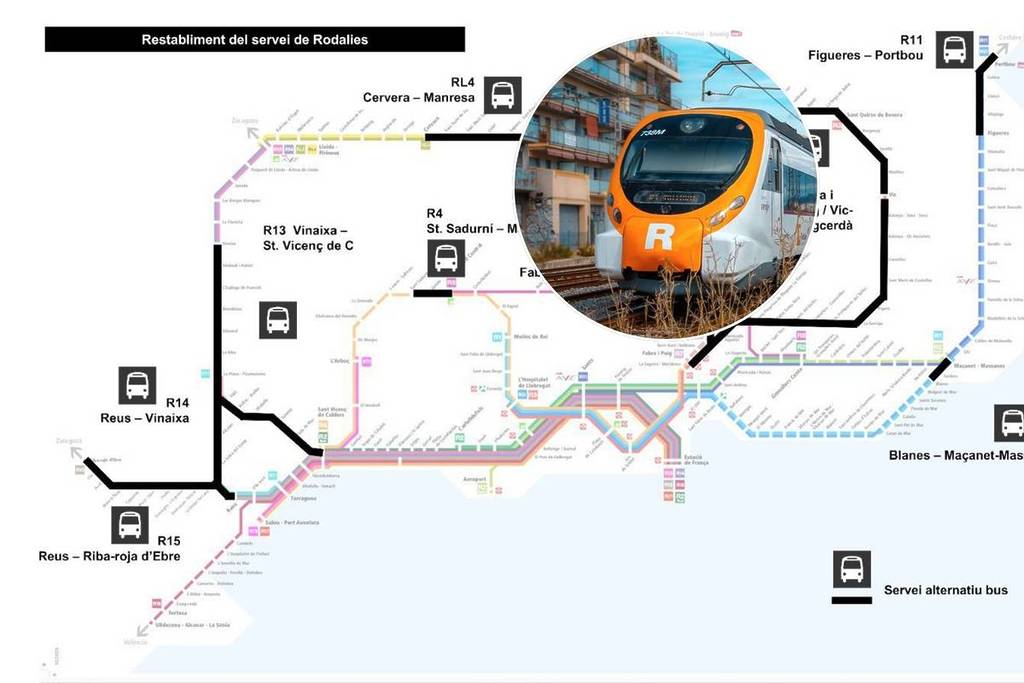
Tomorrow, Monday, it will be time to take a close look at the station timetable again. After a few days of absolute chaos, Rodalies de Catalunya has announced the partial restoration of its service for Monday, January 26.
This is not a return to the usual “arrive and board” service, but rather a railway survival map where patience and road transfers will continue to be the norm at various points across the network.
We’ll tell you which lines will be running and how far they’ll go so that tomorrow you’ll have as few surprises as possible.
Status of Rodalies and Regional lines
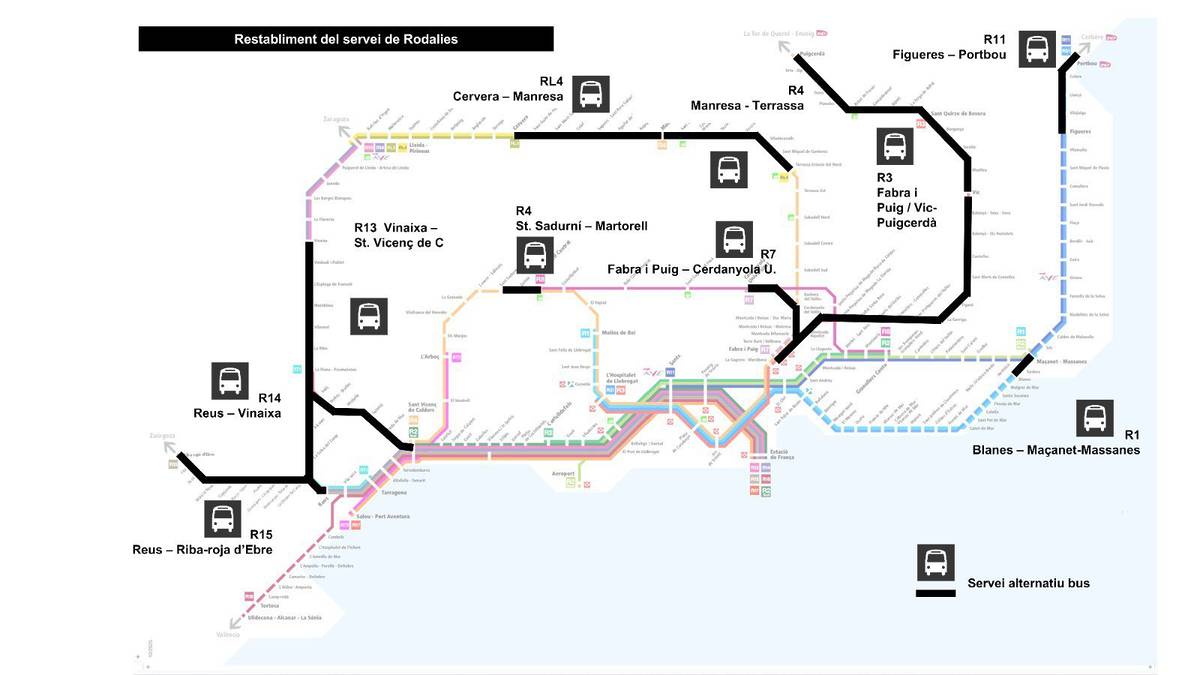
So you don’t get lost among all the codes and colors, here is the mobility map for the start of the week:
-
Lines with normal service: Lines R2, R8, R16, R17, RT1, RT2, and RL3 are back to their usual service along their entire routes.
-
R1 and RG1: Trains are running between L’Hospitalet and Blanes. For the section between Blanes and Maçanet-Massanes, there is an alternative road service. The RG1 also has buses between Figueres and Portbou.
-
R3: This is the most affected line and remains without train service. The R4 should be used to Fabra i Puig, and for the sections to Vic and Puigcerdà, buses with intermediate stops have been provided.
-
R4 and RL4: Trains are running between Martorell and Terrassa, and between Sant Vicenç de Calders and Sant Sadurní. Buses are covering the gaps between Sant Sadurní and Martorell, and between Terrassa and Manresa/Cervera.
-
R11: Trains run between Barcelona Sants and Figueres. The journey from Figueres to Portbou is by bus.
-
R13, R14, and R15: Trains run to Vinaixa (R13 and R14) or Reus (R15). The final sections to Lleida or Riba-roja d’Ebre are covered exclusively by alternative road services.
-
R7: No rail service until further notice, with users being referred to the previously published transport plans.
Stay tuned to the information sources.
Renfe and Adif’s priority is to ensure safety over speed, which means maintaining these strategic closures while technicians work on the ground. For the time being, therefore, extensive use of alternative bus services will be necessary.
The Catalan government and the Rodalies service itself insist that this scenario is dynamic. Although the plan for Monday has already been drawn up, any technical incidents during the night-time safety tests could modify the operational sections.
Passengers are strongly advised to check the official Rodalies app or social media before leaving home, as the frequency of alternative buses does not always match the accuracy of the train schedule.
This phased recovery process seeks to avoid a total collapse of mobility at the start of what is expected to be a busy week. The general recommendation remains the same as always in these cases: if you can telework or leave early, your mental health will thank you for it. Barcelona and its metropolitan area are slowly trying to get back on track.