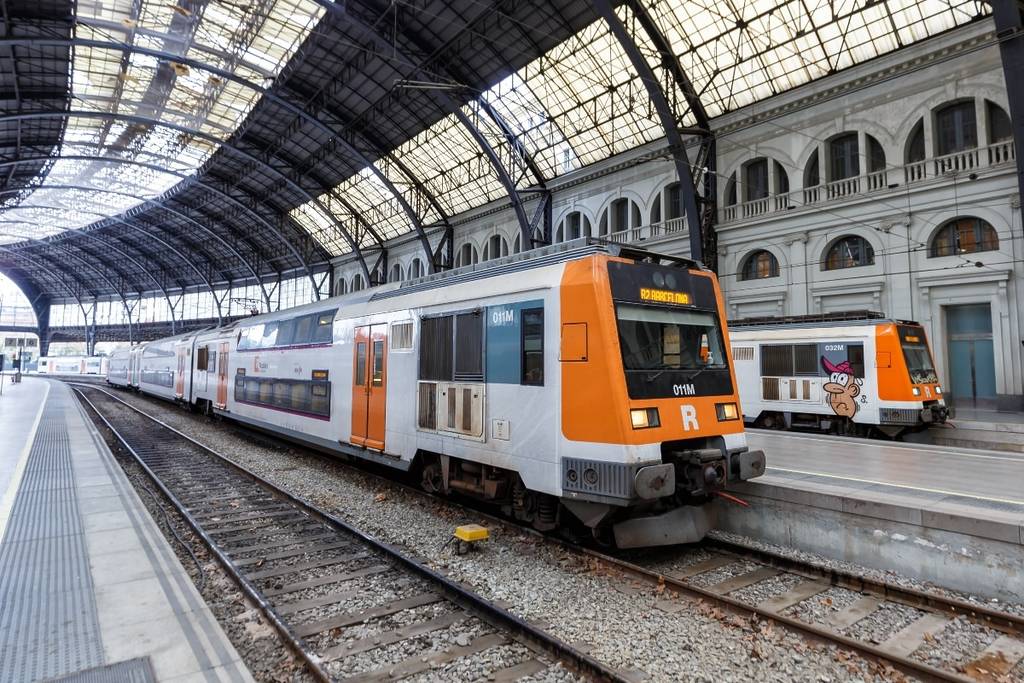
It feels like Groundhog Day, but in a railway nightmare version. If you had plans to leave Barcelona this Saturday or were counting on the train to get around the metropolitan area, it’s time to recalculate your route (and arm yourself with patience). Rodalies de Catalunya has once again suspended all its commuter and medium-distance trains. The service, which already experienced a total shutdown on Wednesday and Thursday after the tragic accident in Gelida, has once again been dealt a fatal blow this afternoon after a morning of uncertainty and misinformation on the platforms.
The decision was not taken lightly. The Catalan government has stood up to Renfe and Adif, and the Regional Minister for Territory, Sílvia Paneque, has demanded a total shutdown of the service until the reliability of the system can be guaranteed. The network is currently under scrutiny in a safety audit after several “black spots” were detected where the ground is unstable.
The trigger: a black week of landslides
What began as a crisis caused by Storm Harry and Storm Ingrid has become a structural problem that has left thousands of users stranded. The service attempted to return to normal on Friday, but reality set in in the form of mud and rocks. A landslide on the R1 line between Blanes and Maçanet-Massanes forced a train driver to slam on the brakes to avoid a major tragedy, reopening a wound that still stings after Tuesday’s collision with a wall on the R4 line.
This Saturday, history repeated itself. A new landslide, this time on the R4 line between Cerdanyola del Vallès and Sabadell Sud, was the last straw for the Catalan administration. Faced with the obvious risk that other sections of the network could collapse due to water accumulation and lack of maintenance on the embankments, a “zero risk” approach has been adopted: trains to the depot and technical inspection of every kilometer of track.
Alternatives and an uncertain future at stations
What now? For the moment, the scene at stations such as Sants and Plaça Catalunya is one of black screens and many yellow vests trying to explain the inexplicable. Alternativeroadtransport plans have been put in place , with shuttle buses on the most critical sections, but capacity is limited and the queues are already beginning to resemble those of the worst days of the strike.
The Catalan government is not only demanding safety, but also compensation for long-suffering travelers. Among the demands on the table is free alternative transport andfree traintravel when services resume, as a gesture for the chaos experienced this week. For the moment, there is no clear time for a return to normal service. The Secretary of State for Transport has traveled to Barcelona to try to resolve a crisis that has already transcended technical issues to become a political and social powder keg. Once again, it is time to look for carpooling options or trust that the buses will be able to cope.