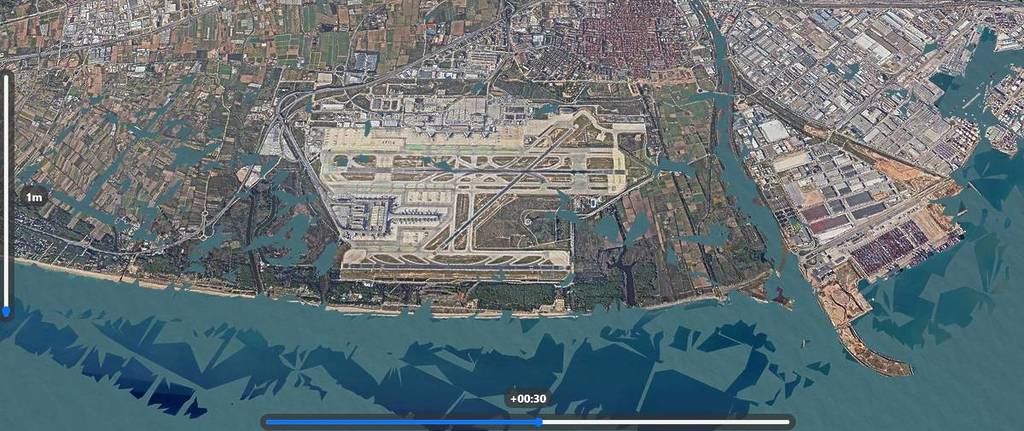
The debate on the expansion of El Prat Airport is at its peak. On the table are proposals for a longer runway and the impact on the natural area of La Ricarda is being intensely discussed. But what if the biggest problem is that they are planning to build, literally, on land that will be flooded?
It is not a hypothesis thrown into the air, but the warning that the researcher and writer Joan Buades has put on the table from his Substack, Llàntia de Foc. In a very complete article that gives food for thought, Buades collects the warnings of a new 3D simulator and a report on critical infrastructures that have turned on all the red lights.
And, let’s face it, the airport is where it is: in the middle of the Llobregat delta, a piece of land reclaimed from the sea that, by definition, plays in the league of sensitive areas. And the possible new runway is projected right there.
A “Google Maps” of the climatic future
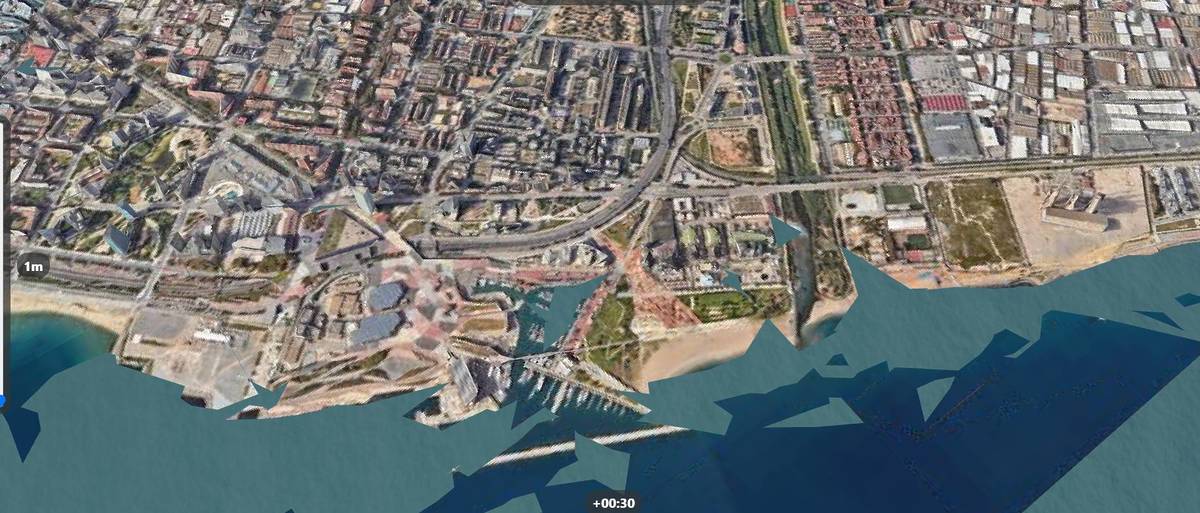
The tool that is raising more than one eyebrow, and which Buades highlights, is called “Sea Level Rise 3D Map”. It is a kind of Google Maps of the climate apocalypse, created by the engineer Akihiko Kusanagi, which allows to visualize in a very graphic way what would happen if the sea level rises.
The result is frightening. With a rise of only half a meter (a scenario that many scientists see as plausible this century), large areas of the airport would already be compromised. If the simulation is set at one meter, the runways and a good part of the Josep Tarradellas terminals would be, let’s say, on a rather worrying beachfront. Or directly, under water.
And not to be prophets of doom, but the experts of Medecc (the network of Mediterranean experts on climate change) have already warned: the Mediterranean is warming 20% faster than the global average.
The report that points to El Prat as a “black spot”.
As if a 3D simulation were not enough, the Llantia de Foc article also puts the spotlight on a recent report by the Observatory of Sustainability (OS). In its analysis of Spain’s critical infrastructures at risk of flooding, Catalonia does not come out very well: we have 868 key facilities in flood-prone areas.
And yes, you guessed it: El Prat Airport is one of them, specifically singled out as a high-risk “black spot”. The report not only takes into account the slow rise in sea level, but also the danger of flooding from torrential rains (the famous DANAs). Does anyone remember what happened on November 4 last year? That’s right.
The curious contradiction of the official maps
Here comes the most curious part. If one, with the fly behind the ear, goes to look at the official flood maps of the Agència Catalana de l’Aigua (ACA), things look different.
On the ACA viewer, which marks the risk zones, the airport runways and terminals appear to be just outside the most likely danger spot (the 100-year return period), although they are surrounded by it and affected by less likely scenarios (500 years).
This generates an interesting debate: do we trust the current maps, based on historical data, or the new projections that simulate a riskier climate future? The debate is a no-brainer and brings us back to square one. The question many are asking is a logical one: does it make sense to invest billions in expanding an infrastructure that, according to these warnings, is in such a vulnerable area?
You may be interested in: Badalona, L’Hospitalet…. the 300 municipalities without a flood plan: check yours.