
Catalan Modernism transformed architecture in the late 19th century and turned Barcelona into one of the most beautiful cities in the world and, in a sense, an open-air museum. Antoni Gaudí is widely known throughout the world, but he was not the only genius who revolutionized the aesthetics and design of buildings; Lluís Domènech i Montaner and Josep Puig i Cadafalch were his two great “rivals” in the field.
Right on Passeig de Gràcia, we have inherited one of the finest examples of this artistic rivalry: the Block of Discord (or Illa de la Discòrdia), where Domènech i Montaner’s Casa Lleó Morera, Gaudí’s Casa Batlló, and the subject of this article—Puig i Cadafalch’s Casa Amatller—come together.
The original building was constructed in 1875 by master builder Antoni Robert, and in 1898, the famous chocolate magnate Antoni Amatller purchased the property for 490,000 pesetas to turn it into his primary residence. Taking into account currency exchange rates and the purchasing power of the time, that would be between 5 and 7 million euros in 2026.
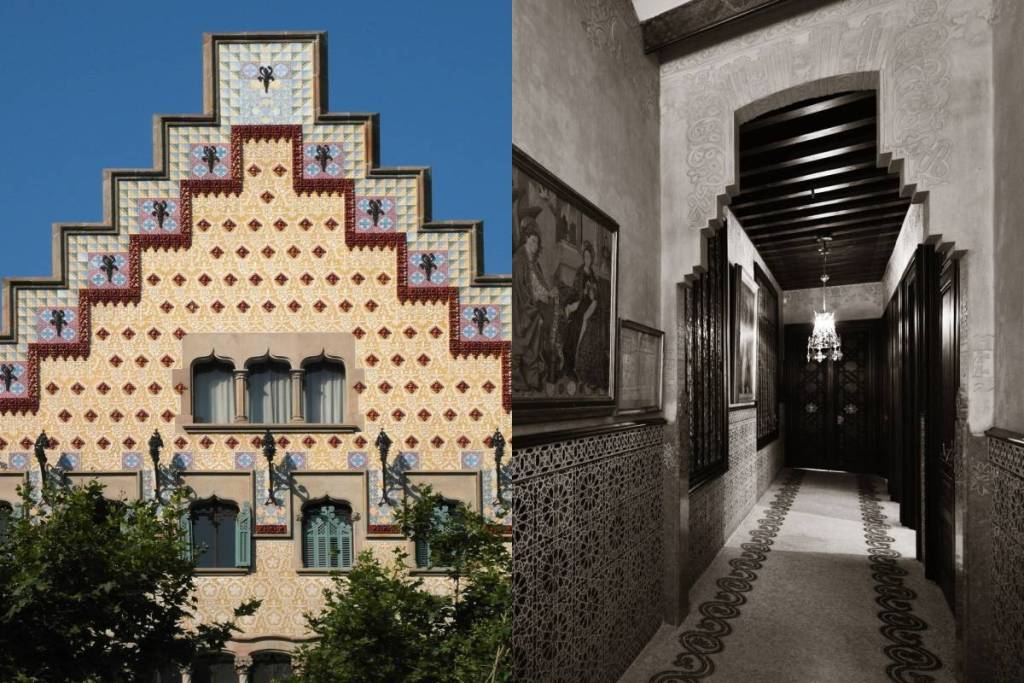
The new owner commissioned the Barcelona architect to completely remodel the home, and Puig i Cadafalch fused Catalan Neo-Gothic with Flemish architecture inspired by Dutch houses. This style is most evident in its striking façade, featuring a stepped cornice clad in ceramic tiles adorned with floral and animal motifs.
A New Life as an Archive and Museum
Teresa Amatller, the owner’s daughter, lived in the building until her death in 1960, at which point the building became the property of the Fundació Privada Institut Amatller d’Art Hispànic, which she herself had founded. After more than half a century serving as an art library and photographic archive, the Barcelona City Council and the Generalitat de Catalunya (along with other institutions) agreed in 2009 on a budget of approximately 5 million euros to fully restore it.
A meticulous and rigorous restoration project culminated in its reopening in 2015 as a house-museum, where visitors can see what the home looked like when the Amatller family lived there.
During the tour, you can see all the original furnishings, Antoni Amatller’s private art collections (featuring paintings, Romanesque and Gothic carvings, and glassware from the Roman and Islamic periods), and the architectural elements designed by the master Josep Puig i Cadafalch. Additionally, you can purchase the Amatller family’s original artisanal chocolate at the museum shop.
A “time capsule” right in the heart of the city that showcases the lifestyle of the upper class at the height of Modernism in the region.