
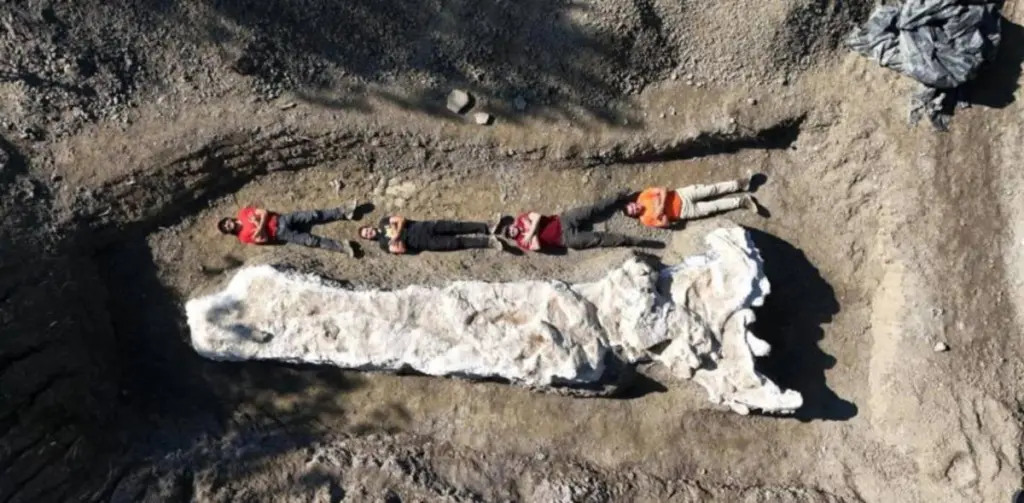

Sometimes we think that to find the giants that ruled the Earth millions of years ago, we have to travel to Patagonia or venture into some remote desert in North America. But the reality is that just a two-and-a-half-hour drive from Barcelona, in the mountains of Pallars Jussà, the ground still hides creatures of almost unimaginable size.
A team of researchers from the Museu de la Conca Dellà and the Miquel Crusafont Catalan Institute of Paleontology (ICP) has just achieved a new historic milestone for the country’s science: the extraction of a titanosaur’s neck at the Molí del Piteu site, near the town of Isona (Lleida). And this is no ordinary neck. All signs point to this being the largest specimen ever recovered in Europe.
Recommended Articles
 Rodalies Strike on November 17: What Are the Minimum Services, and What Times Will Trains Run Tomorrow in Catalonia?
 2026 Christmas Lights in Barcelona: The Lighting Date and Location Have Been Announced
To get a sense of the magnitude of the discovery, one need only look at the scale and the measuring tape. The excavated block weighs more than 15 metric tons and measures up to seven meters long by two meters wide. It is a veritable prehistoric behemoth that lived in these lands some 70 million years ago, right at the twilight of the age of the dinosaurs.
Larger than the legendary Abditosaurus
Pallars Jussà was no stranger to breaking records. In 2014, this same team excavated the neck of Abditosaurus in the nearby town of Orcau—a dinosaur between 15 and 18 meters long that, until now, held the title of the largest of its kind on the continent.
However, initial measurements of the bones from Molí del Piteu suggest that this new titanosaur was in a league of its own—one even higher—and that it most likely belongs to a completely different species that has yet to be named.
The site was discovered five years ago, but excavations did not begin until two years later. What started as the discovery of a few scattered fragments ended up revealing a veritable treasure trove. As Àngel Galobart, director of the Museu de la Conca Dellà and a researcher at the ICP, explains, they kept uncovering long bones until they realized they were looking at a substantial portion—or even the entirety—of the animal’s neck.
An iron “mummy” in a unique state of preservation
Removing 15 metric tons of rock and bone without shattering them into a thousand pieces requires an engineering feat worthy of a movie. To achieve this, the paleontologists had to encase the remains in acrylic resin and build a structure of iron and polyurethane around them. The result is a gigantic protective capsule over six meters long, colloquially known in the trade as a “mummy,” which had to be turned over through complex maneuvers before it could be loaded onto a trailer.
But what really has scientists excited isn’t just the size—it’s what’s inside that fossil:
- Unprecedented findings: Unlike the Orcau specimen, this fossil preserves part of the pectoral region, the forelimbs, and even part of the skull.
- An intact time capsule: As paleontological preparator Elena Nieto explains, the vertebrae appear to be preserved in “anatomical connection.” In other words, they are in exactly the same position they were in when the animal was breathing, which proves that, after its death, its body was not carried away by water currents or scavengers before being buried.
Now the slow and meticulous work in the laboratory begins. The bones will have to be freed from the rock, studied down to the millimeter, and verified to confirm whether, indeed, the Catalan Pyrenees have just gifted the world a new species of prehistoric giant. A perfect excuse to look north and remember that, long before Barcelona existed, titans roamed these lands.
