
The scent of ancient stone in the Gothic Quarter will soon mingle with the aroma of blank pages. There are corners of Barcelona where the past is not found in history books, but in the scars on its facades, in those marks that recall the days when looking up at the sky filled one with dread. However, next Saturday, the clouds over Barcelona will transform to offer a spectacle that seeks to heal the memory through words.
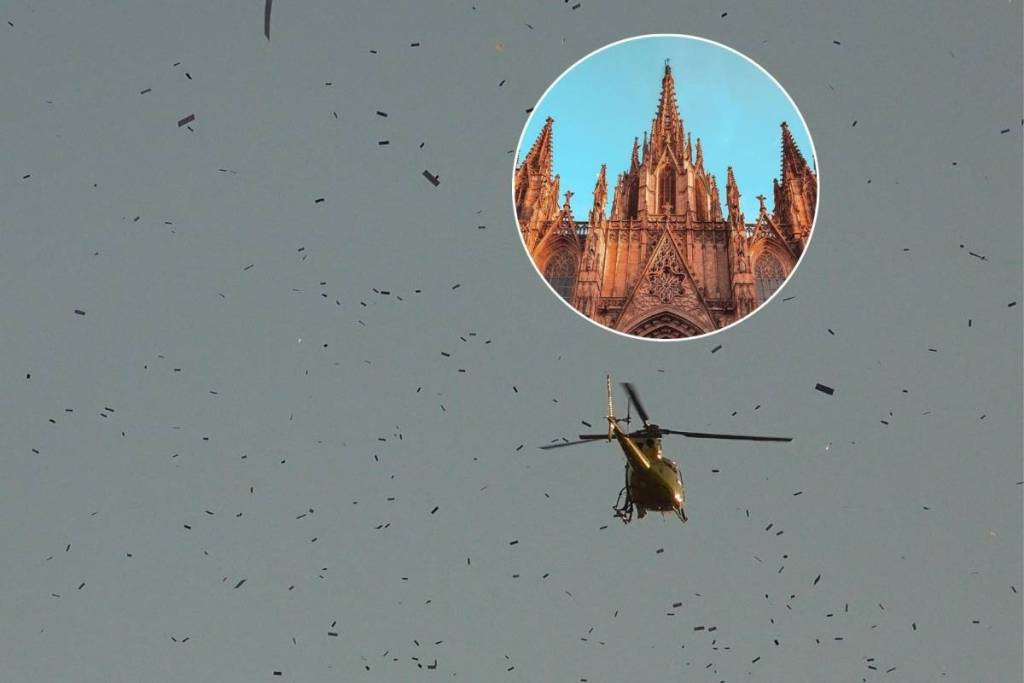
A helicopter will fly over the historic center in the early hours of the night to drop a very special kind of rain. There will be no explosions or destruction; this time, the sky over Ciutat Vella will become a stage for peace and collective culture, seeking to transform the memory of aerial violence into an act of beauty shared among the residents.
A bombardment of poems over Sant Felip Neri
On June 20 at 8:30 p.m., the area around Barcelona Cathedral will host an international public event dubbed “Bombardment of Poems.” A helicopter will cross the Barcelona sky to drop 100,000 printed verses addressing the concept of freedom. The initiative is organized by the Chilean collective Casagrande, which is celebrating its tenth edition in the Catalan capital after having brought this same experience to cities scarred by history such as Santiago de Chile, Guernica, Warsaw, Berlin, London, and Dubrovnik.
The goal of this display is to redefine the meaning of urban airspace. As Julio Carrasco, a member of the Casagrande collective, explains, this action does not aim to erase historical trauma, but rather to make visible the memory that remains inscribed in the streets, reactivating citizens’ emotional connection to the events of their past. The texts will fall in the form of bookmarks so that attendees can collect and keep them.
The memory of Plaza Nueva and Sant Felip Neri
The choice of the area around the Cathedral and Plaça Nova is no coincidence. Between 1937 and 1939, Barcelona suffered the impact of more than a million kilograms of explosives that claimed the lives of over 2,700 people. The Italian Legionary Air Force turned the city’s skies into a testing ground for the systematic destruction of civilian areas, notably the attacks of March 1938, which left nearly 900 dead in just 41 hours.
The area around the Cathedral was one of the zones that suffered most severely from the ravages of war. The clearest example is found just a few meters away, in the Plaza de Sant Felip Neri, where on January 30, 1938, 42 people lost their lives, about twenty of whom were children seeking shelter.
One hundred Catalan poets united in action
For this event in Barcelona, the collective has brought together fifty Catalan and fifty Chilean poets. The poems, which will be distributed in print in both Spanish and Catalan, explore the idea of freedom through concepts such as exile, the body, resistance, silence, and historical memory itself.
The selection of works was made based on gender equality criteria, prioritizing the participation of authors under 50 years of age. In addition to being collected by the public during the event, all the bookmarks that will rain down on the Gothic Quarter will be compiled in a subsequent publication that will bring together the texts alongside images from the event.