
There are summer afternoons when the sky decides to change the script of our daily routine and give us one of those moments that remain etched in our memory. On August 12, after more than a hundred years without one being seen in the country, the moon will completely cover the sun in a total eclipse that will begin its path at 7:20 p.m. in Galicia and move diagonally until it completely obscures the sun in Castellón and the Balearic Islands around 8:30 p.m. In Catalonia, the province of Tarragona and the southern half of Lleida will be plunged into darkness for nearly two minutes, causing temperatures to drop and revealing the stars in the midst of dusk, while in Barcelona and Girona, the phenomenon will be visible only partially.
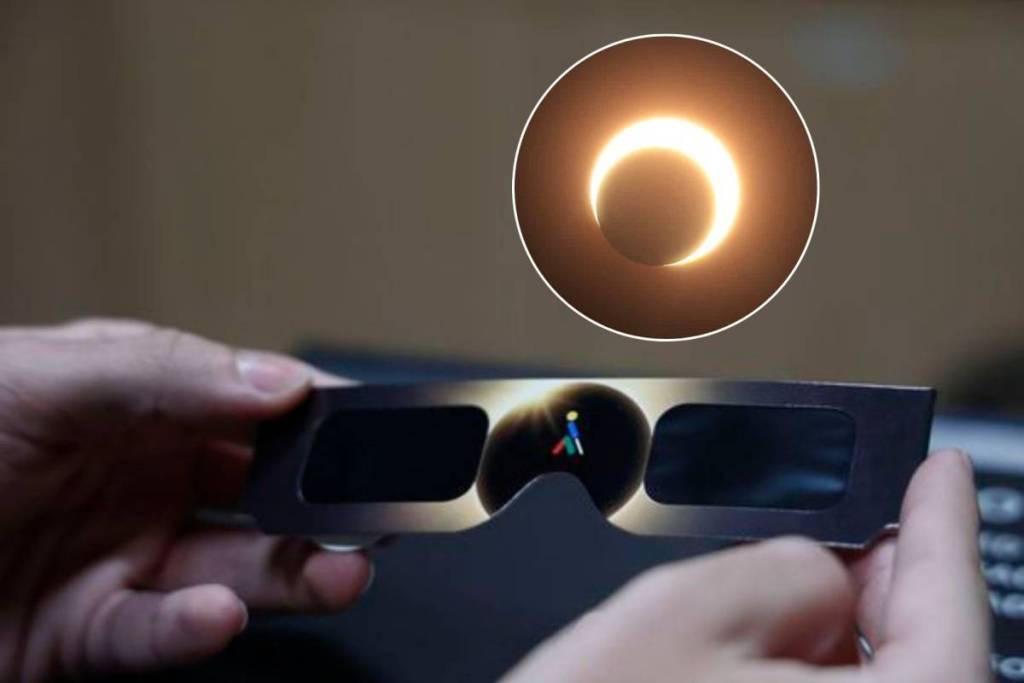
To ensure that the public can safely admire this event without risking irreversible damage to their eyesight, various public and social organizations have launched a distribution network for approved eclipse glasses. Starting Monday, August 3, the Government of Catalonia, the Ministry of Science, Innovation, and Universities, and ONCE will distribute these protective items through observation points, educational venues, and regular service locations.
Pickup locations and number of glasses available
The Catalan Government will distribute 150,000 certified eclipse glasses across the 23 designatedsafe viewing sites setup in 18 Catalan municipalities. Meanwhile, the “A Unique Sight. Take Care of It” campaign, promoted by the Ministry of Science, Innovation, and Universities in partnership with ONCE, is providing an additional two million pairs of glasses nationwide (1.7 million contributed by the social association and 300,000 by the ministry).
To obtain them for free in Catalonia, you can visit the following authorized venues and establishments:
- ONCE lottery retail locations.
- Barcelona Museum of Natural Sciences.
- Mathematics Museum of Catalonia (MMACA), located in Cornellà de Llobregat (Baix Llobregat, Barcelona).
- Montsec Astronomy Park, in Àger (La Noguera, Lleida).
Basic precautions: what you should never use
Viewing the eclipse without proper filters that reduce light and block harmful radiation can cause serious eye damage. For this reason, you must absolutely avoid using any improvised devices or any equipment whose safety you are not completely certain of.
Among the unsafe methods that must be completely ruled out are:
- Conventional sunglasses.
- Exposed analog film.
- X-rays.
- Compact discs (CDs).
- Cameras, binoculars, or any optical instrument that does not have an approved filter always placed in front of the lens.
7 brands of eclipse-viewing glasses approved for use during the eclipse have been recalled from the market
That said, here’s a vital tip before looking up at the sky: make sure to check carefully what you’re wearing over your eyes. Just a few hours before the event, Facua has issued an alert regarding the urgent recall of seven models of sunglasses that were previously certified (including well-known brands such as Mó by Multiópticas and Opticalia, as well as Lionstar, ECP Eye Care Professional, Pelispan, Homanaje, and Orro). The problem is almost like a trap: because they’re too dark, they make it impossible to locate the sun, and, out of pure instinct, the wearer will lift them for a second to look for it, suddenly receiving direct radiation that can cause severe burns to the retina. Given the risk that people may use these defective lenses—which have been sold or given away in recent months—the Department of Health has already strengthened its ophthalmological emergency services as a preventive measure and is urging the public to exercise extreme caution.