
The summer sky has a way of treating us to memorable sunsets,but what awaits us on Wednesday, August 12, 2026, goes far beyond any ordinary postcard. In the late afternoon, the Iberian Peninsula will become the backdrop for one of nature’s most awe-inspiring phenomena: a total solar eclipse. The Moon’s gigantic shadow will sweep across our territory in a diagonal path, offering a visual spectacle that will bring the day to a close before its time.
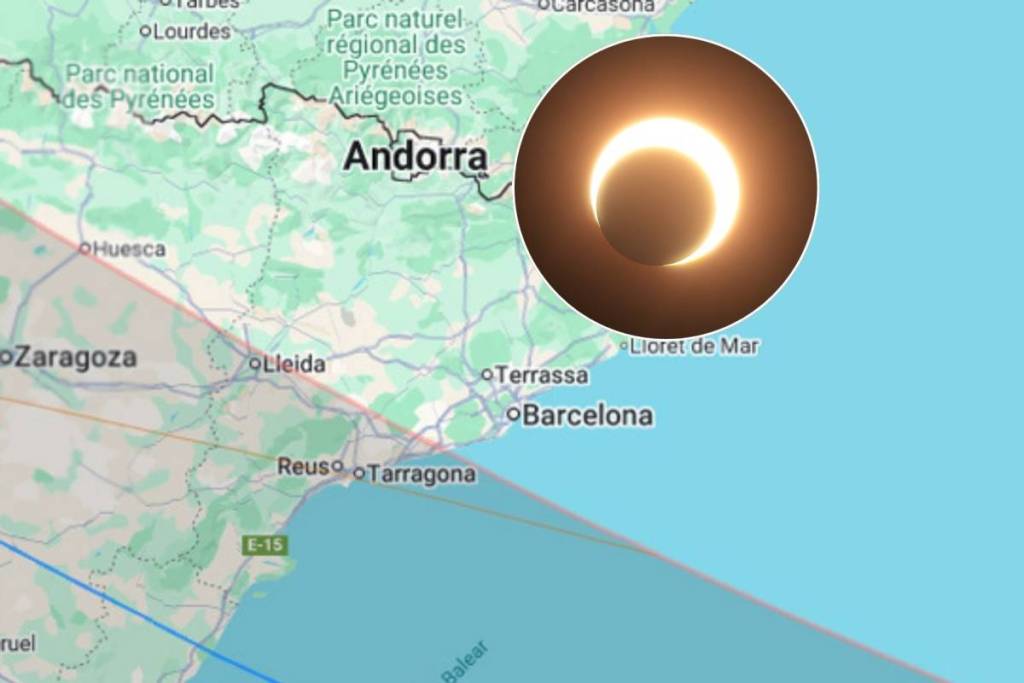
Although this cosmic dance will traverse the peninsula, its mark on Catalonia will be etched with almost surgical precision. While the southern part of the region will experience total darkness that will make the stars shine, Barcelona and northern Catalonia will be just outside the path of totality, experiencing a partial but equally dramatic event. Given the immense anticipation, authorities have set up dozens of viewing spots to gaze at the horizon, anticipating a massive influx of people seeking the perfect spot to bid farewell to an unusually elusive Sun.
Exact date and time of the total solar eclipse in Barcelona
For those staying in the Catalan capital, one thing must be clear from the start: it won’t get completely dark. Barcelona has been left outside that magical band of totality, but what we’ll experience will be worthy of a movie. At 7:35 p.m. (CEST), the Moon will begin to nibble at the Sun’s disk.
The climax will occur at 8:29 p.m. At that moment, with the Sun already skimming the horizon toward the west-northwest, the Moon will block 99.7% of its light. It will be a dizzying sunset where the light will plummet and the sky will take on highly unusual metallic hues. The phenomenon will come to an end between 8:51 p.m. and 8:54 p.m., just as the Sun finally dips below the horizon.
Where is the path of totality in Catalonia?
If you’re itching to see a real total eclipse—the kind where stars light up in broad daylight and the Sun’s corona becomes visible— you’ll have to leave the city and head south. A strip of shadow about 290 kilometers wide will completely cover the province of Tarragona and the southern half of the province of Lleida.
This natural blackout has very strict boundaries:
- The northern boundary: It passes right through the city of Lleida. If you’re in the southern part of the city, such as the Magraners neighborhood, you’ll experience a fleeting 25 to 30 seconds of total darkness. From the city northward (the Pyrenees, Girona, Central Catalonia, or Barcelona), the event will be strictly partial.
- The southern epicenter: The Montsià region takes the prize. Places like Amposta and Alcanar, as well as L’Aldea, will enjoy the longest period of darkness in Catalonia, lasting between one minute and one and a half minutes.
- The Entry and Exit: The first shadows will fall at 8:27 p.m. on the border with Aragon, enveloping towns in the Segrià and Terra Alta regions, such as Gandesa. Minutes later, the coast of Camp de Tarragona (Salou, Cambrils, Altafulla) will be the last stretch of peninsular land to experience nearly a minute of darkness before the shadow leaps into the Mediterranean Sea toward the Balearic Islands.
The 18 mountain huts with perfect views (and free eclipse glasses)
To ensure the experience doesn’t end in a traffic jam on the shoulder—and, above all, to protect the forests from the high risk of August wildfires—safe viewing areas have been designated. Of the twenty or so locations suggested by the Catalan government, eighteen official viewing spots have been set up along the path of totality, designed to accommodate large crowds with parking and unobstructed views of the horizon.
In the Terres de l’Ebre region, viewing sites are massive: the Alcanar bullring (1 minute and 37 seconds of totality), the l’Oriola industrial park in Amposta (4,400 people), or the vast esplanade at Can Gironès in L’Aldea. The Camp de Tarragona region offers spacious venues such as L’Anella Mediterrànea (1 minute of totality), areas in Reus and Valls, or a more intimate spot in Altafulla. In Ponent, the sports complexes in Les Borges Blanques and Magraners (Lleida) will be the main hubs.
To protect our eyes, up to 150,000 pairs of ISO 12312-2-certified eclipse glasses will be distributed free of charge at these locations. All under the watchful eye of 700 Mossos d’Esquadra officers and with the support of drones, which will monitor access points to crowded coastal towns such as l’Ampolla and Deltebre and ensure that no one starts a fire or parks on dry grass.
In addition to the official viewing sites, any elevated spot within the path of totality is a good place to watch the eclipse. That’s why we’re recommending three locations —one close by, one a bit closer, and one farther away from Barcelona—so you can enjoy the eclipse however suits you best.
Where to watch the eclipse if you’re staying in Barcelona
Although Barcelona is not within the path of totality, the eclipse will still be a sight worth witnessing. The degree of solar occultation in the city will be 99.7%, an event that will not occur again for another 154 years, in 2180.
Montjuïc and the Serra de Collserola offer natural vantage points with the best views of the horizon. Montjuïc Castle will open its doors, but tickets are already sold out, so we recommend heading to the Mirador del Migdia or one of the other spots offering an unobstructed view to the west. In the Serra de Collserola, due to its orientation, viewing will be somewhat more difficult, but from the summit of Tibidabo or the Mirador de l’Arrabassada, it’s still possible to enjoy the spectacle.
The upper part of Guinardó Park, near the Fuente del Cuento fountain, also offers an unobstructed panoramic view of the sunset and is one of the best free urban viewpoints. However, if you’re looking for something more private and exclusive, dozens of hotels are opening their terraces and rooftops to let you experience the event accompanied by music, cocktails, and fine dining; Dolce Vitae, Mandarin Oriental, Nobu Hotel, Kimpton Vividora, and La Isabela are just a few of the many options available.
Finally, there are companies offering approximately 4-hour boat tours to experience the eclipse from the sea. Sailwiz,Nautic Ocean, and Creuers Mare Nostrumare just a few of the companies that still have spots available, with prices ranging from 120 to 250 euros per person.
Instructions and precautions for viewing the eclipse
Witnessing an event of this magnitude requires some preparation and plenty of common sense. In terms of location, the key requirement is to find a completely unobstructed western and northwestern horizon. As the eclipse reaches its peak around 8:29 p.m., the Sun will be very low in the sky. Any building, hill, or mountain to your west will block your view of the spectacle.
On the other hand, looking directly at the sun is reckless and can cause irreversible damage to the retina. Forget about homemade tricks: X-rays, tinted glass, and even regular sunglasses—no matter how dark they are—won’t work. The only safe options are certified eclipse glasses (with the ISO 12312-2 seal) or telescopes equipped with specific astronomical filters.
The natural environment also requires protection. August is a critical month for wildfire risk. For this reason, authorities remind the public that it is strictly prohibited to light fires or smoke in the forest, as well as to park vehicles on dry grass. It is vital to take your trash with you, keep dogs on a leash, and obey any forest access restrictions enforced by Rural Rangers. All of this will be monitored by drones, helicopters, and 700 Mossos d’Esquadra officers deployed on the ground.
Be cautious on the roads
The major logistical challenge of this event is the timing. As it reaches its peak around 8:30 p.m., the Sun will be very low in the sky. Therefore, it is essential to find a location where the western horizon is completely unobstructed by buildings or mountains.
Knowing that thousands of people will leave the Barcelona area to head toward the path of totality, roads are expected to be crowded. To manage the influx, the Catalan government has set up 23 official observation sites with large capacities, such as Pla de Camarles or the l’Oriola industrial park in Amposta. If you decide to join this astronomical excursion, we recommend spreading out your travel routes by using alternatives such as the AP-2, the A-2, and the C-25 to avoid traffic jams.