
There are places where summer is unimaginable without gazing at the river that gives them their name and sustenance. Such is the case with the towns of the Ribera d’Ebre, which during these August days celebrate their iconic annual festivals centered around the river. Flix has just wrapped up its main festivities, held from the 12th to the 16th of this month, and now passes the baton to the neighboring towns of Ascó, Riba-roja d’Ebre, and Móra d’Ebre, which are carefully preparing their respective river celebrations.
These festivities, designed to provide relief from the hottest days of the year and strengthen residents’ connection to their natural surroundings, bring together entire generations in a series of games and competitions with deep historical roots. Among all these events, the one in Móra d’Ebre stands out in particular; the town approaches its festival days with pride, having recently been recognized by the Catalan government as a Traditional Festival of National Interest for being the oldest living river festival in all of Catalonia.
Flix marks the start of the festival calendar
The town of Flix kicked off the festivities with a program packed with music, sports, and culture. Among the most unique activities of this year’s event was a wine pairing during the solar eclipse at Castell Nou, in addition to the traditional opening speech by Rita Costa Puey and the proclamation of the 2026 “herederos” and “pubillas.” Residents also took to the streets to enjoy the traditional smashing of pots (trencada de tupins), a lively summer carnival parade, and a performance by the Xiquets de Flix human tower team. The festivities came to a close this past Sunday with the music of the Mirantfont orchestra and concerts by Los 80 Principales and Allioli.
Games, watermelons, and tradition along the river
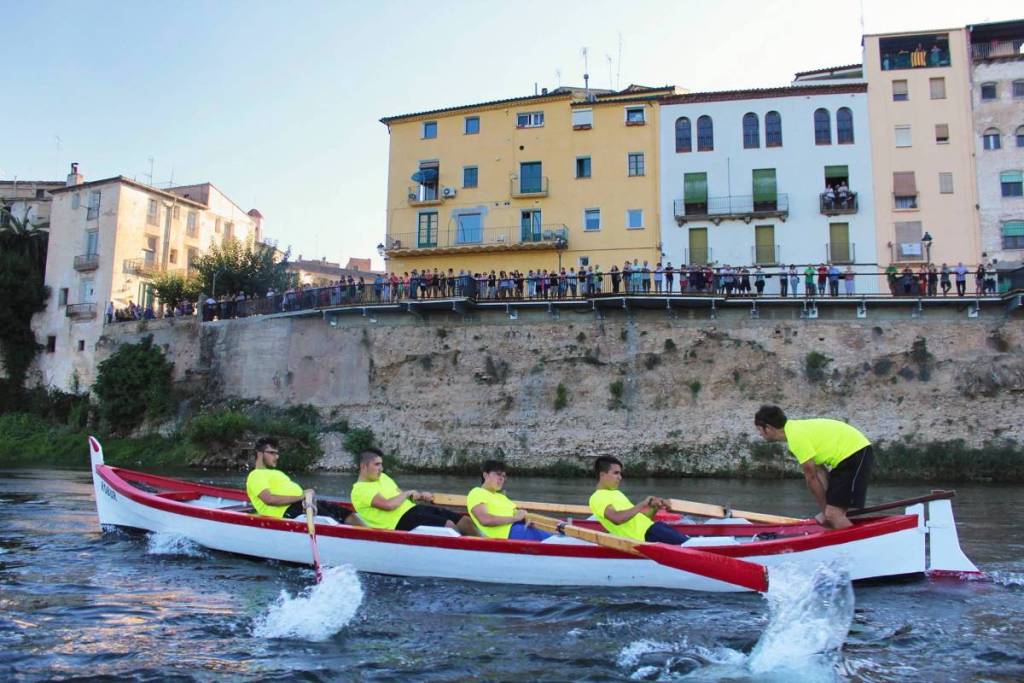
But if there is one thing that truly unites Flix with Ascó, Riba-roja d’Ebre, and Móra d’Ebre, it is the day dedicated entirely to the Ebro River. All these riverside towns share a tradition of fun-filled water games. During these events, young people and children dive in to catch watermelons, try to climb the slippery soapy pole, or jump on inflatable structures. In addition, the competitive spirit comes to the fore in the form of races aboard canoes, “muletas,” and “puntonas”—boats that are an indisputable part of these towns’ history.
Móra d’Ebre and the Weight of Collective Memory
Looking ahead to the coming days, the event in Móra d’Ebre takes on a special luster. Its new designation as a Traditional Festival of National Interest highlights a model of celebration that has successfully passed down the skill, physical effort, and love for the river from one generation to the next. And with good reason: the oldest documented record attesting to the existence of this event on the waters of the Ebro dates back to September 6, 1899, as reported in the pages of the old newspaper *Los Debates*.